

Moving to Le Marche: A Native Italian’s Guide to the Region Most Expats Overlook
Tuscany’s rolling hills and medieval towns at half the price. A native Italian’s guide to moving to Le Marche, from cost of living to earthquakes.

Half the foreigners who move to Tuscany end up wishing they’d looked one region east. A region they probably never considered: Le Marche.
I grew up between Rome (my childhood years) and Marche (from 9 years old onwards), in a small town called Montegiorgio in the current province of Fermo.
When people ask me where in Italy they should consider moving, I often have to fight the urge to just send them my old address and say “here.”
The Marche region might not be a great fit for everyone, but it’s certainly a fantastic option for the majority of people considering a move to Italy.
How do you pronounce Le Marche? Often written as just Marche, it is pronounced leh MAR-keh. Hard k, not soft c.
The Marche region is what Tuscany was 30 years ago: relatively affordable, rolling hills, medieval hilltop towns, excellent wine, beaches on one side and mountains on the other.
The difference is that you won’t find hordes of tourists in Le Marche, and a three-bedroom house with a view costs what a studio does in Florence.
Chock Full of Beautiful Towns and Beaches
The region has 31 towns certified among I Borghi più belli d’Italia (Italy’s most beautiful villages).
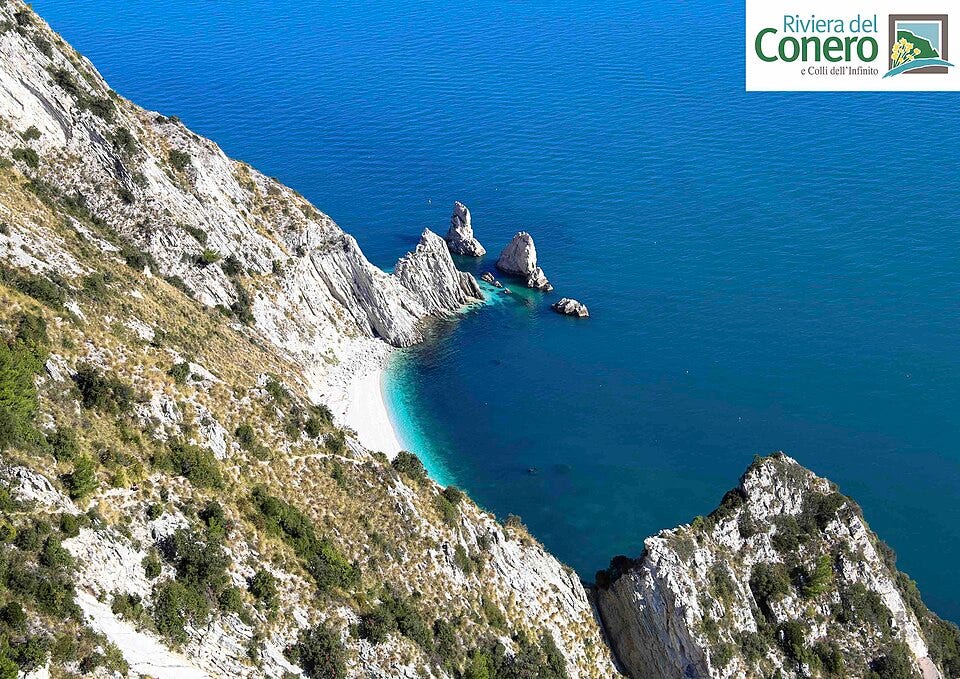
Marche also has a coastline with 20 Blue Flag beaches (in other words, high water quality and safety), and a national park with peaks above 2,450 meters (over 8000 feet).
Ascoli Piceno ranks #22 in Italy for quality of life (according to Il Sole 24 Ore, a financial newspaper who investigates this each year) and just a couple of years ago, it even broke in the top 10. Florence? #36. Rome? Only #46.
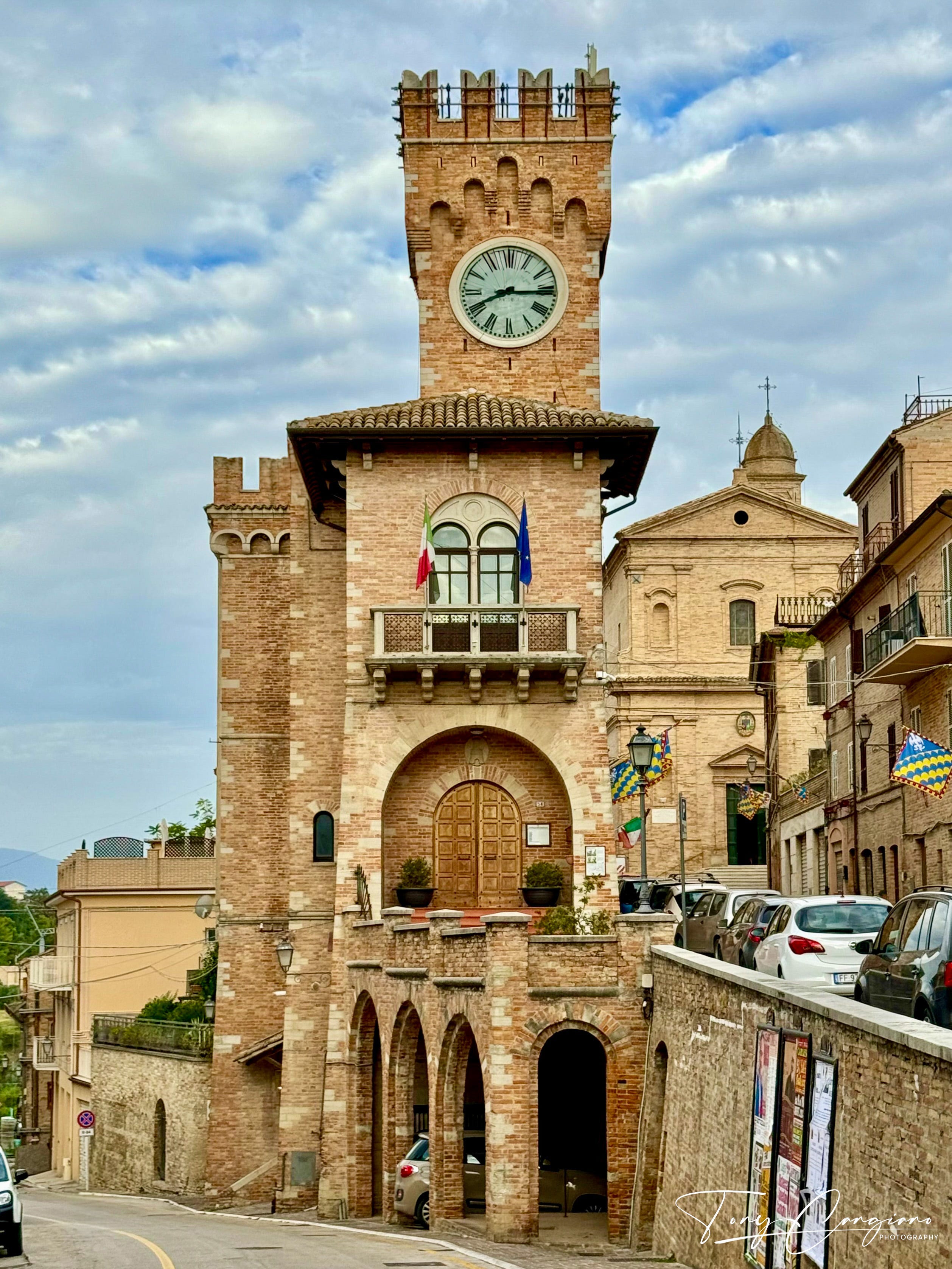
Nobody talks about Marche. And that’s the point.
Subscribe for Future Articles in the Series
This is the first article in a series on moving to Le Marche. In upcoming pieces, for my paid subscribers, I’ll zoom in on three specific cities and their surrounding areas: Pesaro, Macerata, and Ascoli Piceno.
Each will get the full treatment: neighborhoods, cost breakdowns, jobs, schools, hospitals, where to eat, culture, what daily life actually looks like, and more.
These articles will aim to be genuinely useful to those who are serious about moving to Italy. They’ll be specific to the cities I’m mostly considering myself, for my eventual return to living in Italy.
This article is the foundation: the regional overview that helps you decide if Marche belongs on your shortlist at all.
Where Is Le Marche, and What Does It Look Like?
Le Marche sits on Italy’s Adriatic coast, roughly in the center of the country.
It mostly borders Umbria to the west, Emilia-Romagna to the north, Abruzzo to the south, and the Adriatic Sea to the east. (Technically, it also borders Toscana and Lazio).
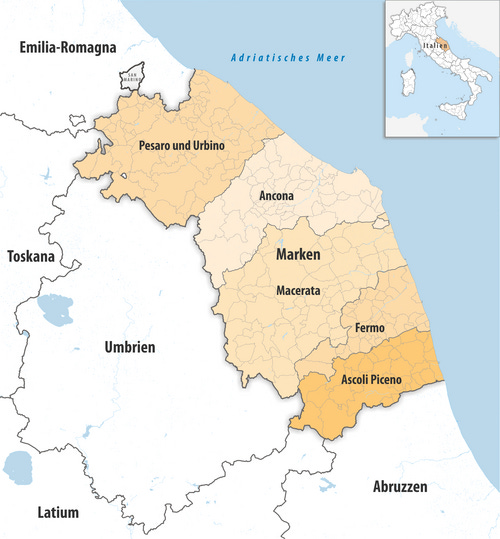
Five provinces make up the region: Pesaro e Urbino in the north, Ancona in the center (i.e., the regional capital), Macerata and Fermo in the center-south, and Ascoli Piceno in the south.
Fun fact: Fermo is a newer province. Growing up, Montegiorgio used to belong to the province of Ascoli Piceno.
If you need a refresher on how Italian administrative divisions work, I wrote about regions, provinces, and municipalities here.
The geography is the region’s best feature. From the coast, the land rises quickly and transforms into soft green hills (the famous colline marchigiane), in a similar fashion to Tuscany. Then from there, it climbs into the Apennine mountains along the western border.
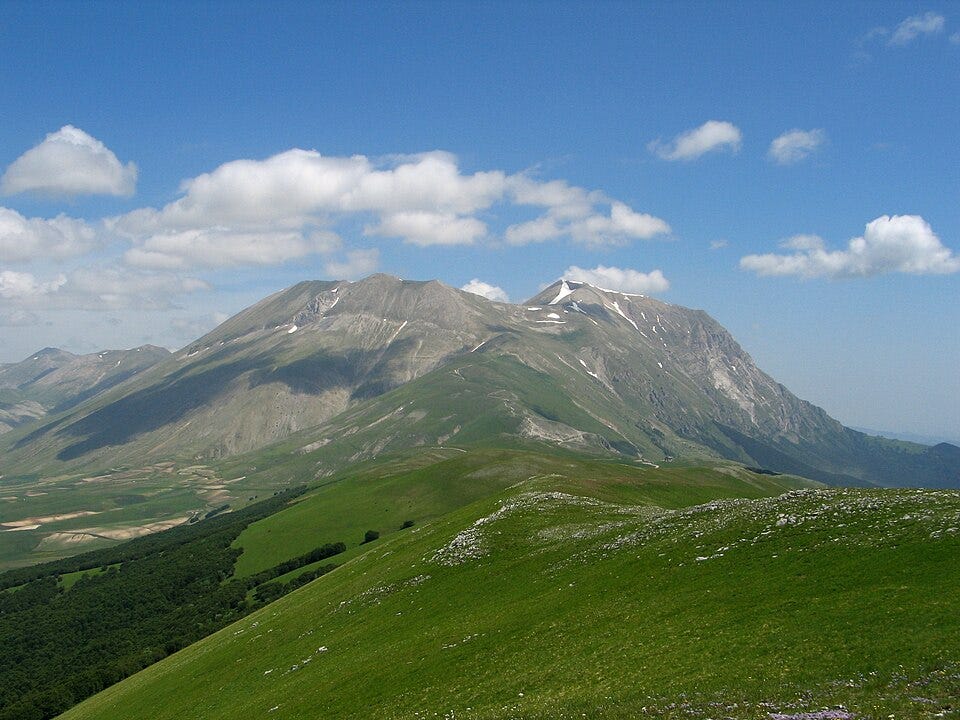
I Monti Sibillini (the Sibillini Mountains), a national park, are genuinely dramatic: high alpine meadows, gorges, wildlife, and peaks over 2,450 meters/8000 feet. You can be on the beach in the morning and hiking at altitude by lunch. The marketing copy for Le Marche writes itself, really.
The population is about 1.48 million, spread across hundreds of small and medium towns. Ancona, the largest city, has roughly 100,000 people. Pesaro has about 95,000. After that, numbers drop fast.
If you’re looking for a major metropolitan area, this isn’t the region. There is no Florence. If you’re looking for a life where you know your butcher and your butcher knows your dog’s name and feeds him scraps, keep reading.
Italians sometimes call Marche “tutta l’Italia in una regione.” All of Italy in one region. That’s not far off the mark. Within 60 kilometers you go from sandy beaches to 2,476-meter peaks (i.e., Monte Vettore).
Between the two: vineyards, sunflower and corn fields, and medieval towns sitting like they were placed there by a set designer. Which, in a sense, they were. Centuries of deliberate defensive hilltop settlement created the skyline.
Climate: What the Weather Actually Feels Like
Living in Canada, this is the part that excites me. The weather in the Marche region is mild and pleasant.
The northern coast (Pesaro, Fano, Senigallia): Winters are cool but not brutal: January averages run 2 to 9°C (36 to 48°F). Summers are warm and comfortable, with July highs around 28 to 29°C (82 to 84°F) and the Adriatic breeze keeping things bearable. Annual rainfall is moderate at about 740 mm.
Snow is rare on the coast (maybe 10 cm a year in Pesaro).
The hills and interior (Urbino, Macerata, Fermo): Move 30 kilometers inland and up to Macerata (sitting at about 300 meters elevation), and things shift. Summers get hotter because you lose the sea breeze: Macerata regularly hits 30 to 31°C in July and August. Winters are colder, with more frequent frost and about 45 cm of snow per year. Rainfall climbs to about 800 to 1,000 mm annually. When the buran (the cold northeast wind from Siberia) sweeps through, it can hit fast and hard.
The southern interior (Ascoli Piceno, Fermo): Ascoli sits in an inland valley ringed by mountains. Winters can be properly cold: lows near 0°C in January, with roughly 58 cm of annual snowfall. Rookie numbers by Canadian standards, but still. Summers are hot, especially when the Garbino (a warm foehn-like wind) kicks in. Ascoli holds Marche’s all-time temperature record: 44°C (111°F) in July 2000. Most summers are less extreme.
The mountains (Sibillini National Park): A different world entirely. Winter lows reach -10°C routinely. Basically a cheaper Canada. Summer up there is gorgeous: 22 to 26°C, wildflower meadows, and the famous fiorita (flowering) of Castelluccio in late June.
How does this compare to Tuscany? Similar annual averages. But Marche winters are colder (that Adriatic exposure), while Marche summers on the coast are often milder than inland Tuscany. Florence regularly bakes at 36 to 38°C in July. It can genuinely be uncomfortable and even dangerous. Ancona often stays under 30°C with the sea breeze. If you hate extreme heat, that’s a major plus for Marche.
The bottom line: The coast and lower hills are comfortable year-round. The interior gets proper seasons. If you want 12 months of warmth, look further south. If you like four distinct seasons without extremes, Marche is where it’s at.
Cost of Living in Le Marche
This is the section everyone skips to first and I can’t blame you. It’s a genuine selling point for Marche.
The average property price in Marche is about €1,610 per square meter. Tuscany’s regional average is €2,640. Florence itself averages €3,337. That means Marche property costs about 40% less than Tuscany overall, and roughly half the price of Florence.
Rent: A bilocale (two-room apartment, meaning one bedroom plus a living area) in Ascoli Piceno’s centro storico runs about €350 to €450 per month. In Ancona, expect €450 to €600 for something similar in a central neighborhood. Pesaro is slightly higher, around €450 to €650, because of coastal demand. In smaller hill towns, you can find a decent apartment for €250 to €350. In Florence, the same apartment costs €1,000 to €1,200. That’s not a small difference. For some, that would be the difference between comfortable and stretched.
Buying: Inland areas (think Macerata province, much of Fermo, the foothills) run €800 to €1,200 per square meter. Fermo province is the cheapest at about €1,264/m². The coast, especially near Ancona and the gorgeous Riviera del Conero, pushes €2,000 to €2,500. A solid three-bedroom apartment in a mid-sized town like Macerata or Ascoli might cost €120,000 to €180,000. A recently renovated farmhouse with land in the interior: €200,000 to €400,000, depending on location and how much work has been done. An unrenovated farmhouse with “potential” (read: serious work is needed): €50,000 to €120,000, plus the same again in renovation costs and several months or years of your patience.
Daily expenses: A cappuccino at the bar is about €1.30 to €1.70. A pizza margherita and a beer: €10 to €15. A lunch at a trattoria, €20 to €25 per person. Groceries for a couple run about €250 to €350 per month if you shop at local markets and supermarkets like Conad or Eurospar. An apericena (the aperitivo that comes with enough food to skip dinner) costs €6 to €8 at most bars. A bottle of local Verdicchio at the enoteca even less than that.
Utilities: Electricity, gas, water, and trash for a 70-square-meter apartment: roughly €120 to €180 per month depending on the season. Internet runs €25 to €30 per month from providers like Fastweb or TIM.
Total monthly budget: A single person can live comfortably in a smaller Marche town on €1,200 to €1,500 per month, all in. A couple, €1,800 to €2,400. In Ancona or Pesaro, add 15 to 20 percent. Of course this is highly dependent on your lifestyle and spending habits, but overall the cost of living is quite reasonable and, I speak from experience, a fraction of the Canadian one.
For context: a comparable lifestyle in a Tuscan hill town would cost you 30 to 40 percent more. The quality of the food, the scenery, and the pace of life are indistinguishable. The price tag is not.
The Food
Every Italian region claims to have the best food. Marche’s claim is quiet, which is usually how you know it’s real.
The region sits at the crossroads of four culinary traditions: Emilia-Romagna’s richness to the north, Abruzzo’s mountain cooking to the south, Umbria’s earthy truffles to the west, and the Adriatic’s fish tradition to the east. The result is a cuisine that is comically diverse for a region this size.
Vincisgrassi is the signature pasta dish: a baked layered pasta (think lasagna, but richer, older, and better) with ragu, béchamel, and often chicken livers or truffles. I’ve written about vincisgrassi before. Every family has a recipe. Every family’s recipe is the correct one. It is better than lasagna. I will not be taking questions.
Olive all’ascolana (aka olive ascolane) are large green olives from Ascoli Piceno, stuffed with a ground meat filling seasoned with Parmesan and nutmeg, breaded, and deep-fried. They’re always served as part of a fritto misto that includes crema fritta (breaded fried custard), which is a sweet-savory combination that shouldn’t work but absolutely does.
Brodetto is the coastal fish stew, and every town along the Adriatic will fight you over the authentic version. Ancona’s traditionally includes 13 types of fish and no tomato. Fano’s uses vinegar. San Benedetto del Tronto’s uses green peppers. The arguments about which is best are never ending.
Ciauscolo is a soft, spreadable pork salume from the interior provinces of Macerata and Fermo. IGP-protected, and it exists nowhere else in Italy. The texture is closer to pâté than salami. You spread it on warm bread. My fiancée Alicia tried it and still talks about it. The first time you try it, you’ll wonder why nobody told you about this sooner. The answer is that marchigiani are terrible at self-promotion.
Truffles. Acqualagna, in the Pesaro-Urbino province, generated roughly two-thirds of Italy’s entire truffle production. Four varieties, available year-round. You can eat truffle on everything here without the eye-watering surcharge you’d pay in Piedmont or Tuscany.
And then there’s maccheroncini di Campofilone (PGI-protected egg pasta so thin it practically dissolves on contact), casciotta d’Urbino (a PDO cheese that Michelangelo reportedly adored), and formaggio di fossa (cheese aged in limestone pits, whose origin is disputed with Emilia-Romagna).
The wines: Verdicchio dei Castelli di Jesi and Verdicchio di Matelica are the flagships. Dry, mineral, excellent with fish. Rosso Conero and Lacrima di Morro d’Alba handle the reds. Marche has 5 DOCGs and 15 DOCs across 700+ wineries. The wines rival mid-range Tuscan bottles at a fraction of the cost.
If food matters to you (and if you’re reading an article about moving to Italy, it probably does), Marche can hold its own against most regions in the country. The difference is that nobody’s heard of it, which means the restaurants are still cooking for locals, not tourists.
If you want to go fancy, there are 8 Michelin star restaurants in the Marche region, including a three star one in Senigallia.
The Main Cities: A Quick Tour
I’m keeping this section brief on purpose. Each of the three cities I’ll zoom in on (Pesaro, Macerata, Ascoli Piceno) will get a full dedicated article for paid subscribers, with neighborhoods, specific prices, schools, and honest day-in-the-life detail. Here’s just enough to orient you.
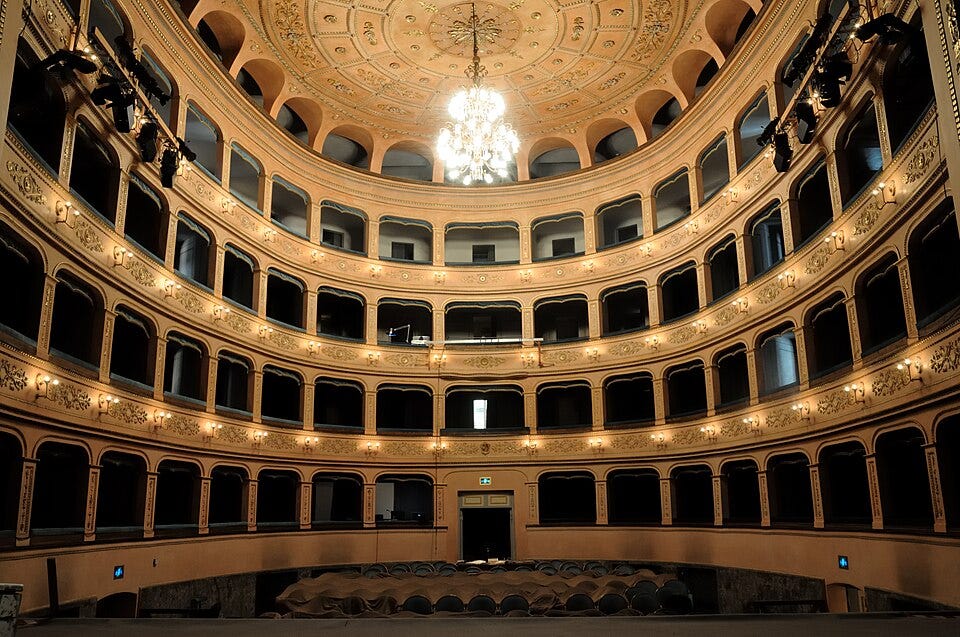
Pesaro
Population about 95,000. On the northern coast, bordering Emilia-Romagna. A beach town with serious cultural credentials: birthplace of the composer Rossini, host of the Rossini Opera Festival every August, designated a UNESCO Creative City of Music in 2017, and named Italian Capital of Culture for 2024. The centro is walkable, the beach is long and sandy, and the 100 km of cycling infrastructure (the Bicipolitana network) is some of the best in Italy. Pesaro’s geographic advantage: it’s the closest Marche city to Bologna, about 1 hour 30 minutes by train. That proximity to a major hub changes everything (more on this below).
Nearby: Fano (old Roman colony, excellent food scene, slightly cheaper), Urbino (one of the most beautiful Renaissance towns in Italy, UNESCO World Heritage Site, home to a major university, 40 minutes inland), Gabicce Mare (tiny beach town on the Romagna border, lively in summer, silent in winter).
Macerata
Population about 42,000. Sits on a hill in the dead center of the region. Known for the Sferisterio, a neoclassical open-air arena that hosts an internationally respected opera season every summer. A proper university town (Università di Macerata, founded 1290) with a young energy that keeps it from feeling sleepy. The old center is small, beautiful, and very livable. On a clear day you can see both the Sibillini Mountains and the Adriatic from the town walls.
Some will consider it blissful, others death by boredom. That’s a feature, not a bug, if you’re a retiree or a remote worker looking for deep focus.
Nearby: Recanati (birthplace of the poet Giacomo Leopardi, with views that genuinely stop you in your tracks), Camerino (university town, heavily damaged in 2016, slowly rebuilding), Civitanova Marche (the beach outlet for Macerata province), Sarnano (thermal spa town, growing expat community).
Ascoli Piceno
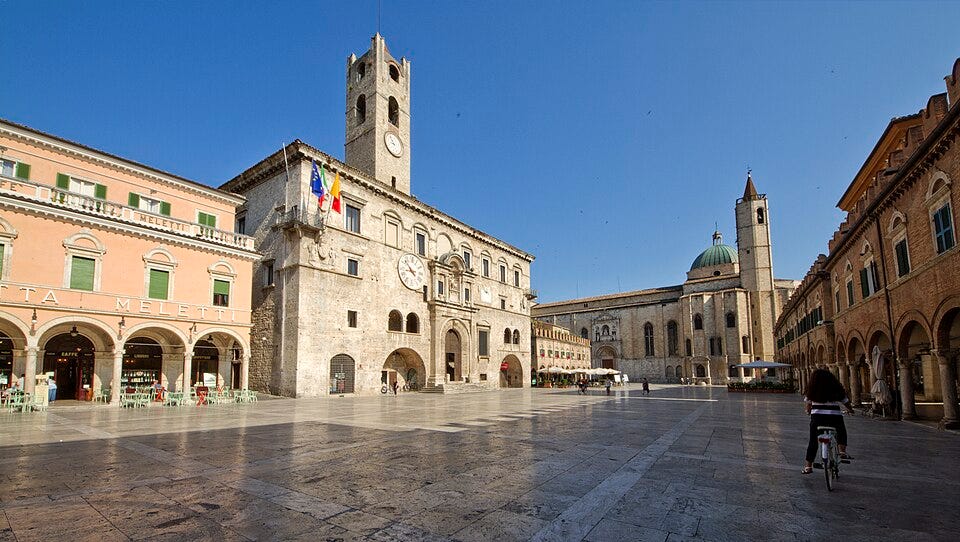
Population about 45,000. In the far south, tucked between two rivers, built almost entirely in travertine stone. Piazza del Popolo is one of the most beautiful squares in Italy, and I say that knowing how many Italian squares compete for that title. Flanked by the Gothic Church of San Francesco and the Art Nouveau Caffè Meletti (serving anisetta since 1870). The Quintana medieval jousting tournament in August involves a 1,500-person Renaissance parade through the streets. It ranked #1 nationally for justice and security, not too long ago.
Nearby: Offida (wine town, famous for lace-making and a genuinely unhinged carnival), San Benedetto del Tronto (the main beach resort of the southern Marche, with the longest palm-lined promenade in the Adriatic), Grottammare (prettier and quieter, medieval old town up on the hill).
Ancona
I won’t zoom in on Ancona in the paid series, but it deserves mention as the regional capital. About 100,000 people, a working port city, home to the region’s main hospital and the Marche Polytechnic University. It’s not pretty in the way Ascoli is. But it’s functional, well-connected, and has the Riviera del Conero on its doorstep: white cliffs, turquoise water, and pine forests that feel like they belong further south. The beaches at Portonovo and Sirolo could pass for the Greek islands.
Fermo
The sleeper pick. Dramatic hilltop position, Roman cisterns underground, Italy’s newest province (2009), and the lowest property prices in Marche. It’s also ground zero of the footwear district where Tod’s, Hogan, and Nero Giardini are headquartered. That said, the shoe industry is in serious trouble (production down over 39% since 2019), which affects the local economy.
Getting Around: Transportation in Le Marche
Here’s the honest truth: you’ll want a car. Every time I visit, I rent a car in the Marche leg of the trip to properly experience the region.
Le Marche is hilly, spread out, and the towns aren’t laid out along a single convenient axis. Public transit within the region is bus-based, infrequent, and oriented toward commuters, not convenience.
You can get away with not having a car if you live (or visit) on the coast and are fine visiting other coastal cities by train.
The good news is that drivers here are not as crazy as in Naples or Rome. You can stop at a red light without the car behind you honking at you.
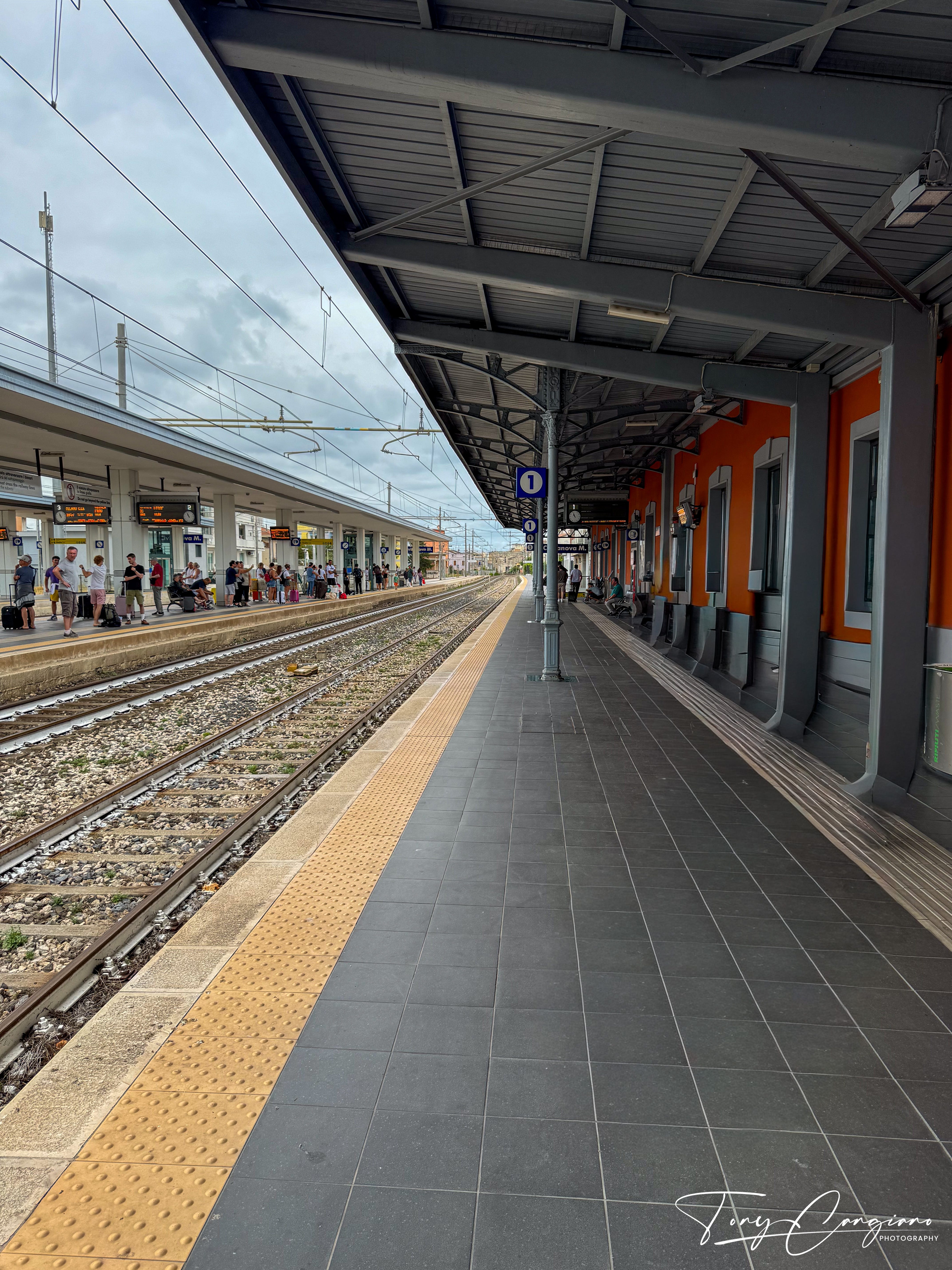
Trains: The main rail line runs along the Adriatic coast, connecting Pesaro, Fano, Senigallia, Ancona, and the southern coastal towns. It’s well-served: Frecciarossa and Frecciargento services connect Ancona to Bologna in about 1 hour 45 minutes, and to Milan in about 2 hours 45 minutes.
Pesaro to Bologna is even faster, about 1 hour 30 minutes. Once you’re in Bologna, you’re on the main high-speed grid: Milan in one hour, Florence in 37 minutes, Rome in a couple of hours. Bologna is Le Marche’s back door to the rest of Italy.
Going inland by rail is harder. There’s a line from Ancona to Rome via Fabriano, but it’s slow. Macerata and Ascoli are served by slower regional connections, often requiring a change at a coastal station. Not ideal, but functional.
I usually land in Rome and then take a Flixbus to Civitanova Marche from Tiburtina. From there I rent a car from Avis or Europcar.
(If you plan a scouting trip, don’t forget to get an International Driving Permit from your local motorization. You’ll need it to drive in Italy. In British Columbia, Canada, I get mine from BCAA.)
Driving: The A14 autostrada runs along the coast and connects to the A1 (Bologna, Florence, Rome) at the northern end. Driving times from Ancona to both Rome and Florence are about 3.5 hours. Bologna shaves off an hour. Inland roads are winding, scenic, and occasionally frustrating in winter.
Airport: Ancona Falconara (AOI) is small but growing. It entered Italy’s top 10 for passenger growth in 2024. Ryanair flies to London Stansted about seven times a week. Routes to Munich, Brussels, Barcelona, and a few domestic cities. For a broader selection, Bologna’s Marconi airport is not too far away.
It’s not Rome or Milan, but you can live in the Marche region and explore Europe if you wish to do so. (You should.)
Bottom line: Budget for a car and keep in mind that gas is far more expensive in Italy. Trains and buses are a good but more limited option.
Jobs, Remote Work, and the Economy
Let’s be direct: if you need a local Italian salary to survive, Marche will be difficult unless you have a specific skill in demand.
The regional economy is built on small and medium enterprises: shoes (the Fermo and Macerata provinces are the heart of Italian shoe manufacturing), hats, furniture, textiles, machinery, and agriculture.
ISTAT data puts Italy’s national unemployment at around 5.3% in early 2026, and Marche hovers near the national average.
Salaries for local jobs are modest: think €1,200 to €1,600 net per month for many positions. That’s Italy, not just Marche.
The good news: Marche is increasingly viable for remote workers. Fiber optic reaches most towns of any real size. If you’re earning a North American or Northern European salary while paying Marche cost of living, your quality of life will be extraordinary. An American making $70,000 working from Macerata is living large, despite the very high tax system.
Starting a business: Italy’s bureaucracy is real but survivable. Marche has virtually no mafia or extortion presence, which puts it in the top tier of Italian regions for business safety. Just get a good commercialista (accountant) and you’ll be fine.
Plus, despite the punishing tax system, small businesses can take advantage of some pretty sweet deals tax-wise. Soon I’ll cover how the tax system works in Italy; subscribe so you don’t miss it.
Retiring in the Marche region is also a great idea. Services like the north, weather and air quality closer to the south. And safety like few other regions in Italy.
Immigration: Visas and Residency
I’ve covered the pros and cons of moving to Italy in depth before, so I’ll stick to what matters specifically here.
Digital Nomad Visa: Launched in 2024. Requires a minimum annual income of about €28,000 to €33,500, a university degree or equivalent professional qualification, health insurance valid in Italy, and proof you’re working remotely for a non-Italian employer or clients. Valid for one year, renewable.
Elective Residency Visa (Residenza Elettiva): For retirees and anyone with passive income (pensions, investments, rental income). You must prove you can support yourself without working in Italy. Consulates typically expect at least €31,000 per year for a single applicant, plus roughly €6,200 per dependent. There is also a special tax rate for obscenely wealthy individuals who make passive income outside the country. Think millionaires retiring in Italy. If this is you, congratulations. Also, buy a subscription to my Substack. :)
EU Citizens: Freedom of movement applies. You’re gold. Register at the local anagrafe (municipal records office) within 90 days of settling in. Bring patience, photocopies, and a codice fiscale (your Italian tax ID). In future articles, I’ll cover bureaucratic topics, such as acquiring a codice fiscale.
Once you have residency, you can enroll in Italy’s public healthcare system (SSN, Servizio Sanitario Nazionale). Voluntary enrollment for non-EU residents costs a minimum of about €2,000 per year. That gets you a family doctor, specialist referrals, hospital care, and most prescriptions.
The quality in Marche is good. And here’s a data point that no other expat guide mentions: the Pesaro-Urbino province ranks #1 in Italy for lowest avoidable mortality. The best healthcare outcomes for preventable death in the entire country. Ancona and Pesaro have both a genuinely good hospital.
A practical advantage of Marche for immigration: the smaller comuni (municipalities) tend to process paperwork faster than Rome or Milan, where wait times stretch for months. In Ascoli or Macerata, your experience at the questura (immigration police office) and the comune will be less painful as well. Not painless, but less painful.
And a point I’ll keep hammering: you need to speak some Italian. In Marche more than most regions of the north. English proficiency is very low outside the university towns.
In the hill towns, it’s close to zero. People are friendly and will try to communicate with you via everything short of interpretive dancing. But there is a limit.
Learning Italian before you arrive (even to an A2 level) will change your experience entirely. The Marchigiani will forgive bad grammar and appreciate you trying. Linguetto, my adaptive Italian practice site, can help.
Safety and Earthquakes
Safety: Le Marche is one of the safest regions in Italy. I’ve written about Italy’s safety profile in detail, and Marche consistently ranks among the lowest for crime.
Petty theft exists (it exists everywhere), but violent crime is very rare. In small towns, people leave their doors unlocked. I’m not romanticizing this. It’s just true. My cousin still doesn’t lock his car. It drives me slightly insane, but nothing has ever happened.
The lack of mass tourism and major urban centers also means that pickpockets are really not a thing in the Marche region.
Earthquakes: This is the paragraph everyone is afraid to write honestly, so I will.
Le Marche is in a seismically active area. In August 2016, a magnitude 6.0 earthquake struck near Amatrice, followed by aftershocks in October that reached magnitude 6.5.
Of the most severely damaged towns, 29 are in the Marche, more than any other affected region. The university town of Camerino, where my high-school best friend teaches, is still rebuilding.
Now the context. The deaths and destruction concentrated overwhelmingly in historic, not up to code, masonry buildings in mountain villages along the Umbria border.
The coastal cities, the hill towns in the center of the region, and the major cities (Ancona, Pesaro, Macerata, Ascoli) were shaken but not seriously damaged. Nobody died or was displaced there.
What should you do? If you’re buying property, check the zona sismica classification (1 through 4, with 1 being highest risk). Check if the building was built to modern seismic standards. Have the property inspected by an ingegnere strutturale (structural engineer) if you are buying an older building.
Budget for potential retrofitting (the Sismabonus tax incentive covers seismic improvement work). And understand that the coast and lower hills carry much lower risk than a 1930s brick house in the mountains.
I would (and probably will) buy a house on the coast of Marche without ever worrying about earthquakes. On a village in zone 1 close to the Apennine spine? I would personally think twice.
So should earthquakes scare you away from Marche? No. The same fault system runs under much of central Italy. If you’re considering central Italy at all, seismic risk is part of the equation everywhere. Millions of Italians live in central Italy without a worry.
Just be informed, buy smart, and don’t build your retirement dream next to an unreinforced medieval tower 20 minutes from Norcia.
Culture, Community, and What Daily Life Feels Like
This is the hardest thing to quantify and the most important thing to get right.
Life in Marche is slow. Not slow in the sense of boring (though some will find it boring, and that’s a legitimate response). Slow in the sense that the rhythm is set by seasons, meals, and local events rather than by a commute or a work calendar.
The sagre (food festivals) that run from spring through autumn in every town are genuinely social events, not tourist performances. There is an overwhelming amount of them.
The passeggiata (the evening walk through the centro) still happens in most towns. The bar where you have your morning coffee is the bar where your neighbors have their morning coffee, and after a few weeks, the barista will start making yours without asking.
The Marchigiani are known among Italians as friendly but reserved compared to, say, Neapolitans or Romans. It takes a bit longer to break in. But once you do, the friendships are deep and the community is real.
Expats who’ve been there a few years almost universally describe the same arc: lonely for three months, tentatively social for six, genuinely integrated after a year. The key is showing up: at the bar, at the sagra, at the local sports club, at the market. Remember: you’re an interesting novelty in Italy. People will want to befriend you.
There’s a meaningful expat community already, concentrated around, of all places, Sarnano and Amandola. As well as some of the coastal towns. English-speaking expats who arrived over the past 10 to 20 years; mostly retirees who bought farmhouses. They can be a lifeline for the first year. Just don’t expect the expat network you’ll find in Florence. Marche offers an authentic Italian experience. You’re diving in with both feet.
The expats who are happiest are the ones who eventually stop socializing exclusively with other expats and build Italian friendships. That’s your goal if you are moving to Italy.
The cultural calendar is richer than you’d expect. The Rossini Opera Festival in Pesaro (August), the Macerata Opera at the Sferisterio (July and August), the Fano Jazz Festival, the Ascoli Piceno Quintana jousting tournament, and dozens of smaller sagre and exhibitions throughout the year.
Maria Montessori was born in Chiaravalle, just south of Ancona. Raphael was born in Urbino. Rossini in Pesaro. Leopardi in Recanati. For a region most people can’t place on a map, Marche has produced an outsized share of Italy’s cultural giants.
And then there’s proximity. It warrants repeating. Bologna is under two hours north via train and brings everything a big city offers. Rome is three and a half hours south. The Adriatic coast of Croatia is a ferry ride from Ancona. You’re not isolated. You’re just in a place that has chosen not to shout about itself.
The Honest Downsides of Marche
No article about moving somewhere is worth reading if it doesn’t tell you what’s wrong.
No big city. If you need the energy, options, and anonymity of a Florence, a Bologna, or a Rome, Marche will feel small. The cities are beautiful but compact. If you get restless in towns under 100,000, this might not be your region.
No international schools. There isn’t a single one in the region. The closest are in Bologna, Florence, or Rome. If your children are young (under 8 or so), they’ll pick up Italian remarkably fast in a local school. Italian kids are friendly, teachers are patient with foreign students, and children at that age absorb language like a sponge. Older children will struggle more initially. This is a real consideration.
Winter can be isolating. The summer is glorious. But from November through March, many of the smaller towns empty out. Tourist infrastructure shuts down. Restaurants reduce hours. If you don’t have a social network and a tolerance for quiet evenings, February in a hill town will test you. If this is a concern, opt for the larger centers like Pesaro or Ancona.
Language barrier. English proficiency in the Marche, especially outside the university towns, is low. You will need Italian. There’s no shortcut.
Bureaucracy. This is an Italy-wide problem, not a Marche problem. In fact, you’ll face less obstacles than in larger cities. But it’s still Italian bureaucracy. If you open a business, a good commercialista becomes a lifeline.
If you’ve read the downsides and you’re still here, that’s a good sign. It means you’re looking for what Marche actually offers, not what you wish it offered.
In my guide to which region of Italy you should move to, I argue that the right region depends entirely on what you prioritize.
Marche is for people who prioritize quality of daily life over access to a metropolis. It’s for people who’d rather eat well every night for €20 than eat expensively once a week for €120. It’s for people who hear “there’s no international school” and think, “good, my kids will actually learn Italian.”
What Comes Next in This Series
This article is the overview. In the coming weeks, paid subscribers will receive deep-dive guides to three cities:
Pesaro and the northern coast: beaches, Rossini, proximity to Bologna, and what life looks like in a mid-sized Adriatic town with cultural ambitions.
Macerata and the central hills: university life, the Sferisterio, property bargains in the surrounding comuni, and the rhythm of a genuine Italian hill town.
Ascoli Piceno and the southern Marche: travertine beauty, the expat community, olive ascolane on every corner, and whether this is really Italy’s best affordable small city.
Each guide will include current rental and purchase prices, neighborhoods, school and healthcare specifics, transport links, and the kind of detail that only matters once you’re seriously considering a move. Subscribe to get them when they are released and to support my work.
National Geographic named Marche a “Best of the World” destination for 2025. Lonely Planet ranked it the #2 region globally in 2020. Foreign tourist arrivals are up 45% since 2019. The window of “nobody knows about it” is closing. I know, amusingly, I’m not helping.
If Le Marche sounds like it might be your place, start with my list of 7 must-see cities in Marche to get a visual sense of the region. Then come back and wait for my deep dives into the three cities I myself am considering.
What draws you to Italy? And have you considered a region that isn’t Tuscany? Tell me in the comments. I read every one.
Frequently Asked Questions
Is Le Marche a good place to retire in Italy?
Yes. Le Marche consistently ranks among Italy’s top regions for quality of life, with low crime, affordable property, excellent food, and a mild coastal climate. Ascoli Piceno ranked #10 nationally in the 2024 Il Sole 24 Ore index. The cost of living is 30 to 40 percent lower than Tuscany for a comparable standard of living. The main trade-offs are lack of major cities and the need for a car.
How much does it cost to buy a house in Le Marche?
Property in Le Marche averages roughly €1,610 per square meter, compared to €2,640 in Tuscany. Inland areas (Macerata, Fermo provinces) run €800 to €1,200 per square meter. Coastal areas near Ancona or the Conero can reach €2,000 to €2,500. A renovated three-bedroom apartment in a hill town typically costs €120,000 to €180,000.
Do I need to speak Italian to live in Le Marche?
Effectively, yes. English is spoken in university towns and some tourist-facing businesses, but daily life, bureaucracy, healthcare, and social integration all require Italian. Reaching an A2 level (test your Italian level here) before arriving will transform your experience and your ability to build real friendships.
Is Le Marche safe from earthquakes?
The western interior, along the Apennine border, is in a high seismic zone and was significantly affected by the 2016 earthquake sequence. The coast and central hill towns are in a moderate-risk zone with modern building codes. If you’re buying property, check the zona sismica classification and have older buildings inspected by a structural engineer. The risk is real but manageable with informed choices. On the coast, in a modern building, you don’t have serious cause for concern.
How does Le Marche compare to Tuscany for expats?
Marche offers similar landscapes, food, and wine culture at 30 to 40 percent lower cost. Tourism density is about a quarter of Tuscany’s. Marche also has 180 km of Adriatic coastline with 20 Blue Flag beaches. What Marche doesn’t have is a city like Florence, extensive international flight connections, or global brand recognition. If you want the Tuscan lifestyle without the Tuscan price tag and tourist crowds, Marche is the answer.