

Which Region of Italy Should You Move To?
A native Italian's honest guide to choosing the right region by lifestyle, budget, and what actually matters once you're there.

“Which region of Italy should I move to?” is one of the most common questions I receive from students and friends interested in moving to Italy.
I grew up between Rome and the Marche region. I studied in Milan. My family is from the Naples area. I’ve now lived in Canada for over two decades, and I think about moving back to Italy more often than I’d like to admit.
So this isn’t one of those articles written by someone who spent two weeks in Tuscany, fell in love, and came back with opinions. I have opinions because I’ve lived the regional differences. I still have family and friends scattered across the country who keep me abreast and honest about what’s actually going on.
Most “which region” guides treat Italy like a photo catalog. Oh, Sicily is so beautiful. That’s useless. The real question isn’t which region is the prettiest. It’s which region fits your life. Your income source, your tolerance for bureaucracy, your health needs, your appetite for chaos.
Some people might find the generalizations offensive, but I back them with data, and they are real patterns that would affect your life in Italy.
Let’s start there.
First, figure out what you’re going to do for money
This is far more than important than scenery. Your income situation will eliminate half the country before you even look at the map.
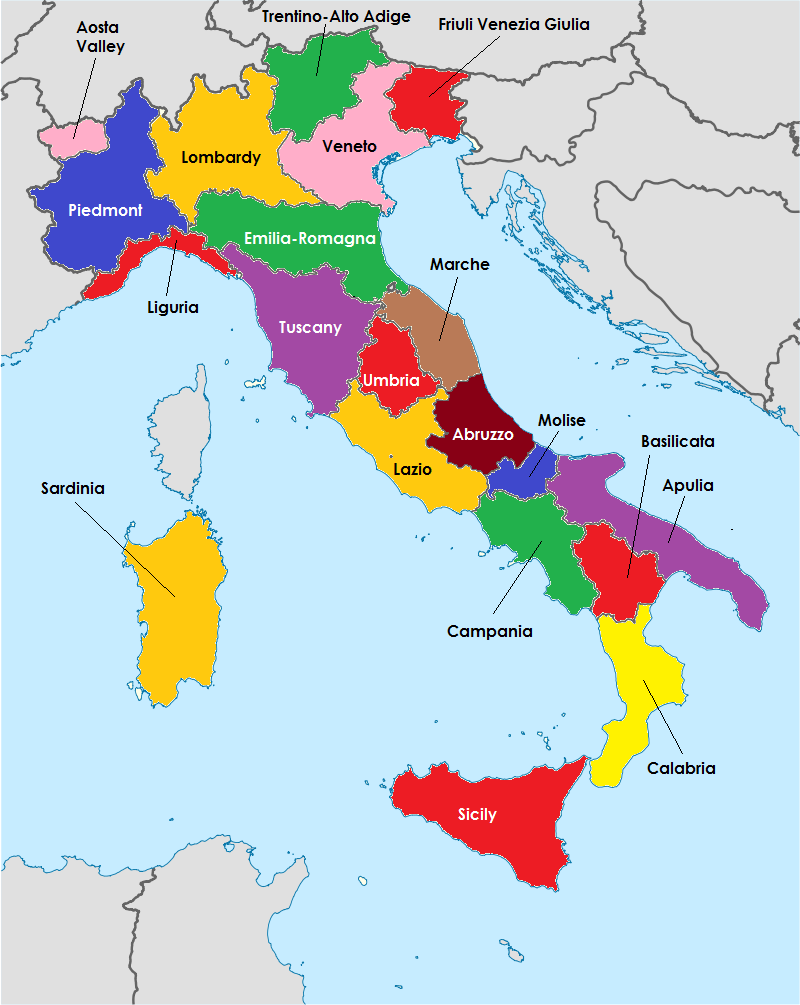
If you’re retiring on a foreign pension, the south becomes appealing. Italy offers a 7% flat tax on foreign pension income if you relocate to a qualifying southern town with fewer than 20,000 people. That covers regions like Sardinia, Sicily, Calabria, Puglia, Campania, Basilicata, Molise, and Abruzzo. The tax break is significant.
Combine it with the south’s lower cost of living (rent starting at €350/month in parts of Calabria, groceries 20% cheaper than the national average) and you can live genuinely well on a modest pension.
The trade-off is weaker healthcare infrastructure, fewer services, and depending on how far south you go, a pace of life that is incredibly slow. Some will consider it blissful, others death by boredom.
If you’re hoping to find a local job, your options narrow down dramatically. Italy’s national unemployment rate dropped to a record 5.1% in early 2026, but that number is a lie of averages. The northeast sits at 3.6%. The south at 11.9%. In Calabria, youth unemployment is 42.6%, nearly half of young people looking for work can’t find it. Sicily and Campania aren’t much better at 35 to 43%.
Realistically, if you need a local paycheck, you’re looking at cities like Milan, Rome, Bologna, etc. Milan has the most international job market by far, but I’ll get to why I’m not its biggest fan shortly.
If you have a remote job, congratulations, the whole country is yours. Open a partita IVA (freelance tax registration) or work through your foreign employer, and you can live almost anywhere. Italy’s digital nomad visa requires roughly €28,000/year in income for non-EU citizens.
With remote work, you can choose based on quality of life rather than employment opportunities. That opens up the entire center of the country, which is, in my opinion, the sweet spot.
If you’re thinking of opening a physical business (a shop, a restaurant, a B&B), location matters enormously, and not just for marketing reasons (i.e., location, location, location). In parts of the south, businesses face a problem that relocation guides prefer to gloss over: the pizzo, or protection money demanded by organized crime.
This isn’t ancient history. A February 2025 police operation in Palermo resulted in 181 arrests and documented 50 extortion cases in just two years. Estimates from anti-mafia investigators suggest around 80% of Sicilian businesses pay some form of pizzo.
The amounts aren’t trivial: according to Confcommercio surveys, the average runs about €457/month for retail, €578/month for restaurants and hotels, and over €2,000/month for construction firms. If you refuse, your shop might have an unfortunate fire. Or your car.
There’s a courageous anti-pizzo movement called Addiopizzo with over 1,000 member businesses in Palermo fighting this, but the system persists.
Sicily and Calabria are the worst for this. In regions like Tuscany, Umbria, Marche, or Emilia-Romagna? Virtually unheard of.
The same Confcommercio survey found just 2% of businesses had ever received an extortion threat. That alone should factor into your decision if you plan to open a retail store.
Why I’m not a fan of Milan
Every relocation guide will tell you Milan is Italy’s economic engine. That’s true. It’s also, according to Il Sole 24 Ore’s 2025 crime index, Italy’s highest-crime city: 6,952 reported crimes per 100,000 inhabitants. That’s first in Italy for total thefts and street robberies. First for snatching.
Now, context matters. Milan’s homicide rate is just 0.5 per 100,000, lower than London or Paris. The high number is overwhelmingly property crime.
But the everyday friction is real. Phones stolen on the metro. Bags grabbed at Stazione Centrale. Chains snatched off your neck. Car broken into. If you’ve lived in a safe North American suburb for years, Milan will feel like a shock.
Then there’s the maranza problem. If you haven’t heard the term, maranza refers to gangs of mostly second-generation teens. The word exploded nationally in 2022 after a chaotic gathering of about 2,000 youth at Peschiera del Garda, organized via TikTok, that devolved into brawls, stabbings, and sexual harassment on trains.
I’m not scaremongering and it’s not the end of the world. But it is a big-city problem rooted in housing shortages, failed integration of immigrants, absent youth services, and lackluster law enforcement. All amplified by social media.
Milan is also the most expensive major city in Italy. A two-room apartment runs about €1,158/month. The general cost of living sits at the top of the Italian scale. You need a strong income to begin to justify it.
In the end, it’s still Italy. It’s still beautiful. Food is still good. But you have many better alternatives in my opinion.
Rome is a mixed bag
Rome is a different story. I love Rome. It’s an open-air museum. The food is extraordinary. Carbonara in its homeland, cacio e pepe, supplì done properly, carciofi alla giudia. There’s a warmth to Roman life that Milan simply doesn’t have.
But Rome comes with its own issues. Traffic is exhausting. Public transport is unreliable at best. Bureaucracy is Kafkaesque even by Italian standards. And while it’s cheaper than Milan (rent averages about €895/month for a bilocale), it’s still expensive relative to what you get in services.
In the Il Sole 24 Ore quality of life rankings, Rome sits around 46th out of 107 provinces. That feels accurate. It has everything, but nothing runs particularly smoothly.
Don’t ignore air quality in Italy
This deserves its own section because almost nobody talks about it, and it could be a dealbreaker for some of you. It is for me.
The Po Valley (the Pianura Padana) has some of the worst air pollution in Europe. Not just Italy. Europe. The valley is enclosed by the Alps and Apennines like a bowl, trapping pollutants.
Take a look at the map below. It’s extremely easy to spot.
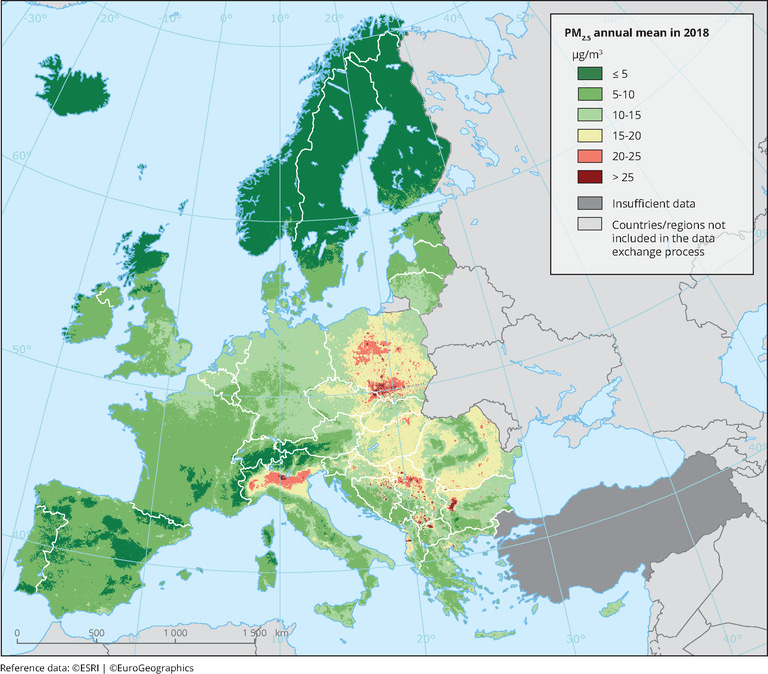
Annual PM2.5 in Milan runs 3-4 times the WHO annual guideline.
During a particularly bad stretch in February 2024, Milan recorded a daily PM2.5 nearly 24 times the WHO annual guideline of 5 µg/m³.
Of the 96 monitoring stations nationally that exceeded limits, 80 were in the Po Valley. That’s 83%.
(No, I didn’t have these numbers memorized, I had to look them up. But everyone in Italy knows that the air pollution in the North is awful.)
And this isn’t just an inconvenience. Italy records an estimated 43,000 to 50,000 premature deaths annually from air pollution.
Compare that to Rome at roughly 13 µg/m³ (still bad, but decent for such a large city) or Sassari in Sardinia at just 6.
Central Italy (Tuscany, Umbria, Marche) generally sits at 6 to 15 µg/m³. Still above the WHO ideal, but a different world from what you’re breathing in Lombardy or the Veneto lowlands.
For someone like me who’s had serious health issues, this alone eliminates most of the north. Though, the extreme north of the country has very clean air.
If you’re considering Emilia-Romagna, and I understand the appeal, know that Bologna’s lowlands share the Po Valley’s air quality. It’s really not ideal. South of Bologna are better, but you’re trading it for remoteness.
The Romagna coast (Rimini, Ravenna, Forlì) is somewhat better because the Adriatic provides ventilation, but it’s not perfect either.
The earthquake question nobody wants to talk about
I might come across as a negative Nancy, but I must warn you about a few things people don’t consider when planning to move to Italy. I like to keep it real.
Italy classifies every municipality into four seismic zones. Zone 1 is the most dangerous; Zone 4 is the safest. The central Apennine stretch, running through Umbria, Marche, Abruzzo, all the way to Calabria, is the country’s most active seismic belt.
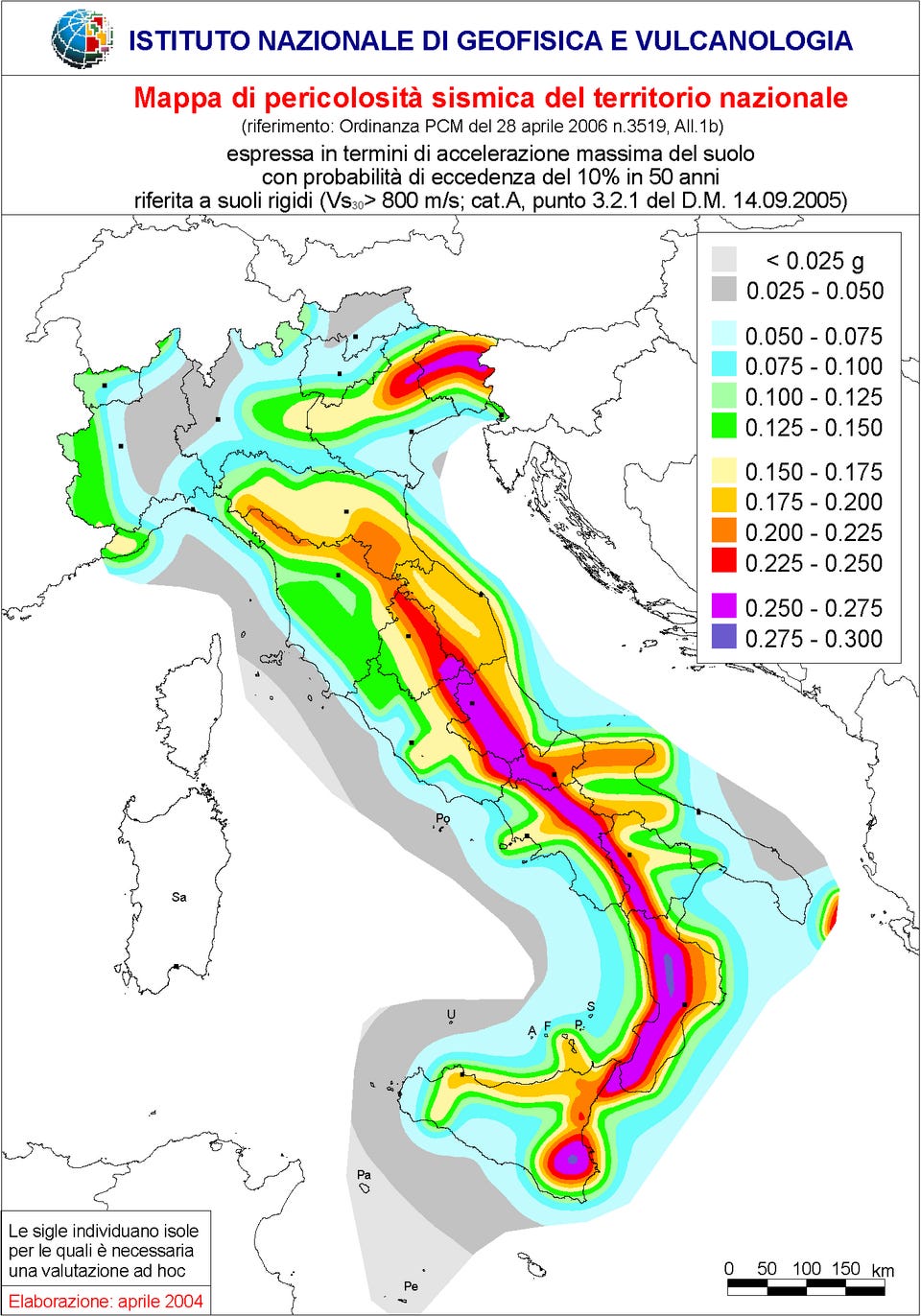
This isn’t theoretical. In 2009, L’Aquila in Abruzzo was devastated with 308 dead and 67,000 displaced.
A 2016 earthquake killed 299 people in Amatrice in the northeast Lazio area near Abruzzo and Marche. That same year, in October, another earthquake hit Norcia near Perugia in Umbria and nearly leveled the Basilica of San Benedetto.
Before that, the 1997 Umbria-Marche earthquake damaged over 100,000 buildings and severely harmed the Basilica of San Francesco in Assisi. I still remember my bed shaking violently at the time and the cracks in the walls left by the earthquake in my small Marche apartment where I grew up.
Umbria is one of Italy’s most exposed regions: 18 municipalities in Zone 1, 51 in Zone 2, 23 in Zone 3, and zero in the safest Zone 4.
Marche is predominantly Zone 2, with over 90% of municipalities at medium-high risk.
Abruzzo straddles Zone 1 along the ridge. L’Aquila is one of Italy’s highest-risk cities. But coastal and northern Abruzzo (Pescara, Teramo) sits in the somewhat safer Zone 2.
Liguria has no Zone 1 or Zone 2 municipalities at all. It’s entirely Zone 3, the safest of my preferred regions by far.
Tuscany is mostly Zone 3, which is reassuring.
Sardinia is almost entirely Zone 4, the safest region in Italy for seismic risk.
This doesn’t mean you can’t live in Umbria or Marche. Millions of Italians do. But if you’re buying property, check whether buildings have been upgraded to modern anti-seismic codes (adeguamento sismico).
Factor the local seismic history into your decision. Don’t just fall in love with a stone farmhouse without understanding what Zone 1 actually means.
The quality of life rankings tell a clear story
Every year, Il Sole 24 Ore ranks all 107 Italian provinces across 90 indicators covering wealth, employment, environment, demographics, safety, and culture. In 2025, Trento (extreme north) leads at 648.7 points. Reggio Calabria (extreme south) sits last at 394.9. That’s a 254-point gap which stood for 36 years of rankings.
The top 10 is exclusively northern: Trento, Bolzano, Udine, Bologna, Bergamo, Trieste, Verona, Milan, Monza, Parma. The bottom is entirely southern. No southern province has ever cracked the top 20.
Yes, it’s a financial newspaper that might be biased towards wealth factors, but it’s still quite telling.
Here is where a few regions I’m considering myself fall on that index:
Marche: All five provinces in the top half. Ascoli Piceno at 22nd, Macerata around 25th.
Emilia-Romagna (Romagna side): Bologna 4th, Forlì-Cesena 11th, Ravenna 19th. Extraordinary.
Tuscany: Ranges from Siena at 21st to Pistoia around 66th. Depends heavily on which province.
Abruzzo: Pescara jumped 15 places to 40th. L’Aquila sits at 69th.
Umbria: Perugia at 37th, Terni at 48th. Solid middle.
Liguria: La Spezia and Genova in the low 40s. Imperia at a weak 79th.
Lazio: Rome at 46th. Viterbo mid-range. Latina and Frosinone in the bottom quarter.
You can explore the full interactive rankings at lab24.ilsole24ore.com/qualita-della-vita. Look up the provinces you’re interested in. Compare them.
The regions I’d actually consider
Here are the regions I’d personally consider and why.
Marche
A personal favorite but the data agrees.
Why it works: All five provinces rank in the top half nationally. Property runs €1,200 to 1,600/sqm. A nice apartment in a hill town costs what a parking spot does in Milan. A bilocale in Ascoli Piceno rents for about €400/month. Four hundred euros. You get the Adriatic coast (not Sardinia, but real sandy beaches), classically beautiful interior hills, and the Sibillini mountains an hour away.
The food is criminally underrated. Olive all’ascolana are an amazing aperitivo snack (provided you like olives). Vincisgrassi is Marche’s answer to lasagna and I honestly prefer it to the Emilian version (though both are great).
Crime is among Italy’s lowest. Healthcare is solid, with good hospitals in Ancona, Fermo, and the other provincial capitals.
I spent my teenage years in Montegiorgio, a small town in the province of Fermo. The pace was wonderfully slow. Maybe too slow when I was 17 and craving excitement. But now, at my age, with, say, a remote job and a desire to actually enjoy life? Quite workable.
The downsides: Limited job market. This is a remote-work or retirement region, not a career-building one. Seismic risk sits mostly in Zone 2. Train connections are decent along the coast but thin once you go inland. Winters in the interior can be cold and damp, though not Po Valley grim.
Best for: Remote workers, retirees, families wanting affordable quality of life, anyone who values food and peace over nightlife and career ambitions.
Romagna (eastern Emilia-Romagna)
The Romagna coast and its immediate hinterland (Rimini, Forlì-Cesena, Ravenna), not Bologna proper, though Bologna deserves mention.
Why it works: Emilia-Romagna places six provinces in the national top 20 for quality of life, which is extraordinary for any region. Forlì-Cesena sits at 11th, Ravenna at 19th. The food culture here is arguably Italy’s greatest: tagliatelle al ragù, prosciutto di Parma, piadina romagnola, aged balsamic vinegar that costs more than wine and is worth every cent.
Ravenna is a genuinely underrated city. Byzantine mosaics that rival anything in Istanbul, a real cultural life, not overrun with tourists. Rimini has reinvented itself beyond its party-town reputation. The coastal air quality is noticeably better than Bologna’s lowlands because the Adriatic provides some ventilation.
People from Romagna are also famously warm and sociable. This matters more than you’d think when you’re an outsider trying to build a life.
Bologna deserves a specific note. It’s a wonderful city. Stunning arcades, one of the oldest universities in the world, food that makes you want to cry. It ranks 4th nationally in quality of life. But it’s very left-leaning politically, which shapes daily life in visible ways.
There’s a high tolerance toward behaviors and customs that not everyone will be comfortable with. That’s neither inherently good nor bad; it’s a cultural reality you should experience before committing to. Rent averages €784/month for a bilocale, which is a bit high due to the constant influx of students, and it does share the Po Valley air quality.
The downsides: Inland Emilia-Romagna has a genuine smog problem. Bologna’s PM2.5 levels are in the same bracket as Milan. The Romagna coast is better but not immune. Summer tourism in Rimini can be overwhelming. Not cheap by central Italy standards, though much cheaper than Milan.
Best for: People who want strong services, cultural vibrancy, and world-class food with better air than Milan. Especially the Ravenna/Forlì-Cesena corridor.
Tuscany
Not the Tuscany of postcards and British expat fantasy. The quieter, less polished parts: the Maremma (around Grosseto), parts of Arezzo province, the southern Siena hinterland.
Why it works: You get the Tuscan landscape (rolling hills, cypress trees, vineyards) without Florence’s prices and tourist crush.
Grosseto province is significantly cheaper than Siena or Florence. Services are solid, healthcare is excellent (Tuscany’s regional health system is one of Italy’s best), and the food is the food: bistecca alla fiorentina, ribollita, pappardelle al cinghiale, cantucci with vin santo.
Seismically it’s mostly Zone 3, which is reassuring. Air quality is good. The Maremma coast is beautiful in a wild, less manicured way: Cala Violina, the Argentario peninsula, Castiglione della Pescaia.
The downsides: More expensive than Marche or Abruzzo, even in the less famous areas. Florence province ranks 2nd nationally for reported crime (mostly tourist-area theft), though southern Tuscan provinces are much calmer. Job opportunities outside of tourism and agriculture are thin. Some areas feel seasonal: vibrant in summer, quiet in winter.
Best for: People who want the Tuscan dream at a realistic budget, retirees, remote workers who value beauty and services and don’t mind paying a bit more than central Italy’s cheapest.
Abruzzo
Specifically the Pescara and Teramo provinces. Not L’Aquila, which is beautiful but sits on one of Italy’s most dangerous fault lines.
Why it works: Pescara province jumped 15 places to 40th in the quality of life rankings, which signals a genuine improvement. Property averages €1,381/sqm, some of Italy’s cheapest outside the deep south. Rent in Pescara runs about €510/month. You get coast and mountains in the same region, which is rare at this price point.
Pescara itself isn’t a beautiful city, let me be honest. It’s functional, a bit chaotic, and architecturally unremarkable. But it has an airport (small, but it exists), decent hospitals, and the surrounding area is genuinely gorgeous: Francavilla al Mare, Ortona, and the Trabocchi coast to the south, where those ancient wooden fishing platforms are unlike anything else in Italy.
The food is better than people realize: arrosticini (tiny lamb skewers grilled over coals, addictive), maccheroni alla chitarra, sagne e fagioli. Abruzzo also qualifies for the 7% flat tax for retirees in municipalities under 20,000 people.
It is geographically in the center, but culturally often considered a southern region.
The downsides: Earthquake risk increases sharply as you move inland. L’Aquila is a permanent reminder. Infrastructure is weaker than Tuscany or Emilia-Romagna. Fewer international flights. The region can feel isolated, especially in winter in the interior.
Best for: Budget-conscious retirees (with the flat tax), remote workers who want coast-plus-mountains cheaply, people willing to trade polish for authenticity.
Lazio
Not Rome. The area north of Rome: Viterbo province, the Tuscia, Lake Bolsena.
Why it works: Stunningly beautiful and absurdly cheap by Roman standards. Medieval hill towns like Civita di Bagnoregio (the “dying city”), volcanic lakes, excellent local food (acquacotta, fresh lake fish, wild boar).
Close enough to Rome that you can take a train down for a museum visit, a specialist doctor’s appointment, or a proper night out. Viterbo has a university, so there’s some young energy.
The downsides: Quality of life rankings for Viterbo are mid-range, nothing stellar. Public transport connections outside the Rome train line are weak; you’ll want a car. The area is relatively unknown to international expats, which means fewer English speakers and less of a ready-made community (though some would consider that an advantage). Southern Lazio (Latina, Frosinone) ranks poorly and I’d avoid it.
Best for: People who want proximity to Rome without Rome’s costs and chaos. Retirees who value beauty and space. Anyone who wants a genuinely Italian experience without an expat bubble.
Liguria
The Italian Riviera, specifically the eastern side around La Spezia, Lerici, and the Cinque Terre hinterland.
Why it works: The coast is beautiful and the climate is mild year-round, warmer in winter than almost anywhere else in northern Italy. The massive advantage is seismic safety. Liguria has zero Zone 1 or Zone 2 municipalities. It’s entirely Zone 3. If earthquakes are a dealbreaker for you (and they might be after reading the section above), Liguria solves that problem.
The food is distinctive: focaccia di Recco (thin, filled with stracchino cheese, life-changing), trofie al pesto made with Genovese basil, farinata, fritto misto di mare. La Spezia is a real working city with port energy, not a tourist museum.
The downsides: Liguria is narrow and steep. Flat land is scarce, which drives up property prices in desirable spots and makes mobility challenging for anyone with physical limitations. Western Liguria (Imperia province) ranks a dismal 79th in quality of life.
The economy is weak outside Genoa. Winter, while mild on the coast, brings relentless damp and grey in the hills. And everything is more expensive than Marche or Abruzzo.
Best for: Retirees prioritizing climate and seismic safety, people with a good budget who want coastal living without southern Italy’s service gaps.
What about Umbria, Puglia, and Sicily?
These three come up in every relocation conversation, so let me be direct about each.
Umbria
Beautiful, affordable, and culturally rich. Lake Trasimeno is gorgeous. I’ve spent many summer days there. Perugia has real character, a university, good restaurants. Property averages just €1,178/sqm, and a couple can live on €2,000 to 2,500/month total. Quality of life rankings are solid mid-table (Perugia 37th, Terni 48th).
But. The seismic risk is hard to ignore. Umbria has 18 municipalities in Zone 1, 51 in Zone 2, and zero (zero) in the safest Zone 4. The 2016 earthquake devastated the eastern part of the region. The 1997 quake damaged over 100,000 buildings. If I’m being honest, this is a big reason I’d hesitate despite loving the area.
And there’s no sea. I know that sounds trivial, but if you’re moving to Italy and you’re already coming from an inland Canadian city, part of the appeal is the Mediterranean coast. Or the Adriatic one. Trasimeno is lovely for a Sunday, but it’s a lake.
Umbria is also more isolated than it looks on a map. Rome is over two hours by car, and train connections thin out quickly once you leave Perugia.
Still, for the right person, it’s exceptional value. I’ll be spending several days there during my May trip, and part of me suspects I’ll fall in love with it again.
Puglia
Fantastic as a destination. The food is extraordinary: orecchiette con cime di rapa, burrata that hasn’t travelled 3,000 kilometers, bombette pugliesi, raw seafood in Bari that will ruin you for sushi forever. The coast is stunning. The masserie and trulli are architecturally unique. The climate is warm almost year-round.
But as a place to actually live? Unemployment is high. Healthcare infrastructure is weaker than in the center-north. Organized crime is present (the Sacra Corona Unita plus encroachment from the Camorra and ‘Ndrangheta) though less pervasive than in Sicily or Calabria.
Services can be unreliable. For a holiday, it’s perfect. For a permanent base, think carefully unless you’re retiring with a strong pension and few service needs.
Sicily
One of the most beautiful region in Italy. The history, the architecture, the food: arancini, pasta alla Norma, cannoli that actually taste like they should, granita in summer.
But you need to go in with eyes open. Beyond the pizzo issue for anyone opening a business, daily services can be unreliable. Healthcare facilities outside Palermo and Catania are thin. Youth unemployment is above 35%. Bureaucracy makes the rest of Italy look efficient by comparison.
The infrastructure gap with the north is real and it affects daily life in ways you don’t expect until you’re trying to get a document processed or waiting for a repair that was promised two months ago.
For a retiree with a good pension, a tolerance for chaos, and no need to rely on Italian services for income? It can be paradise. For everyone else, it’s beautiful but demanding.
The budget option: small towns in the middle of nowhere
Italy has hundreds of tiny towns. In culo ai lupi, as we say (warning: vulgar expression), literally in the wolves’… backyard. Places where you can buy a house for under €50,000 and live on very little. Some municipalities have run famous “€1 house” schemes to attract buyers. Sambuca di Sicilia, Mussomeli, places in Sardinia and Molise.
The reality of these places: genuinely shocking slowness. The nearest supermarket might be 30 minutes away. Your neighbors are elderly, lovely, and speak dialect you won’t understand for the first two years. Winter can be isolating in a way that hits differently when you don’t have family nearby.
This can be beautiful if it’s what you want. I know people who thrive in it.
But my honest suggestion, even if you’re on a tight budget, is to find a small town within 15-30 minutes of a decent-sized city. That way you get affordability and peace without cutting yourself off from hospitals, shops, and social life.
A small town in the hills behind Ascoli Piceno, or in the Monti Sibillini foothills, or along the upper Pescara valley, or in the Maremma interior south of Grosseto. You can rent a nice place for peanuts, drive to a proper city when you need to, and still be surrounded by the kind of landscape that made you fall in love with Italy in the first place.
One more thing: wherever you end up, visit first. More than once. In different seasons. That Tuscan hill town that’s magical in June might feel like a ghost town in January. That coastal Romagna apartment that seems perfect in August might be hit by freezing Adriatic winds in February.
Two towns 20 kilometers apart can feel like different countries. Spend time there before you commit.
You’ll need Italian
I saved this for last because it applies everywhere. Even in Milan, even in Rome, daily life in Italy requires Italian.
Since 2018, you need at least B1-level Italian to apply for citizenship through naturalization. But more than the legal requirement, you need it to navigate bureaucracy, build real friendships, understand your lease, talk to your doctor, and actually feel at home rather than like a permanent tourist.
This is what I do. I teach Italian. If you’re even remotely considering a move, start now. Subscribe to this newsletter if you haven’t already. Download my free guide on studying Italian daily. Practice with Linguetto, my adaptive Italian learning platform. The earlier you start, the more doors will be open when you arrive.
Italy doesn’t make it easy. It never has. But if you put in the work: the language, the patience, the willingness to let things be slower and messier than you’d like, it gives back more than anywhere else I know.
When you do meet it halfway, there is no better place to live. And that’s why even I am considering it more seriously, despite living quite well in Canada.
I’ll let you know what I decide.