

Is Italy Safe? 25 Safety Tips for the Paranoid Traveler: Pickpockets, Scams & Staying Safe
Italy is safe, but pickpockets and scams are real. 25 practical tips on street safety, common tourist traps, and what to actually worry about in 2026.

Visiting Italy is a dream for a lot of people. But somewhere between booking the flight and packing your bags, you fall into a Reddit rabbit hole about pickpockets in Rome. Suddenly you’re shopping for money belts, decoy wallets, anti-theft backpacks, and are half considering a bodyguard.
A student of mine (let’s call him Mark) messaged me two days before flying to Rome with a list of questions that could have been a thesis. “Should I leave my passport at the hotel? Can I wear a watch? Is the train station safe after 8 PM? Does Italy have Uber?”
Mark had a great trip. Nobody pickpocketed him. Nobody scammed him. He ate incredibly well and is now asking me about moving to Italy with a digital nomad visa.
The concern made sense. The level of it didn’t.
I grew up in Italy, between Rome and the Marche region, studied in Milan, my family is from the Naples area. I’ve seen most of the country, and it’s a very safe place to visit.
Tourists almost never run into violent crime. Muggings are rare. There’s nothing here that should make you cancel your trip.
What you do get, especially in big cities, is petty theft. Pickpockets, bag snatchers, and street scammers who’ve been perfecting their craft since (and I mean this literally) the 1600s.
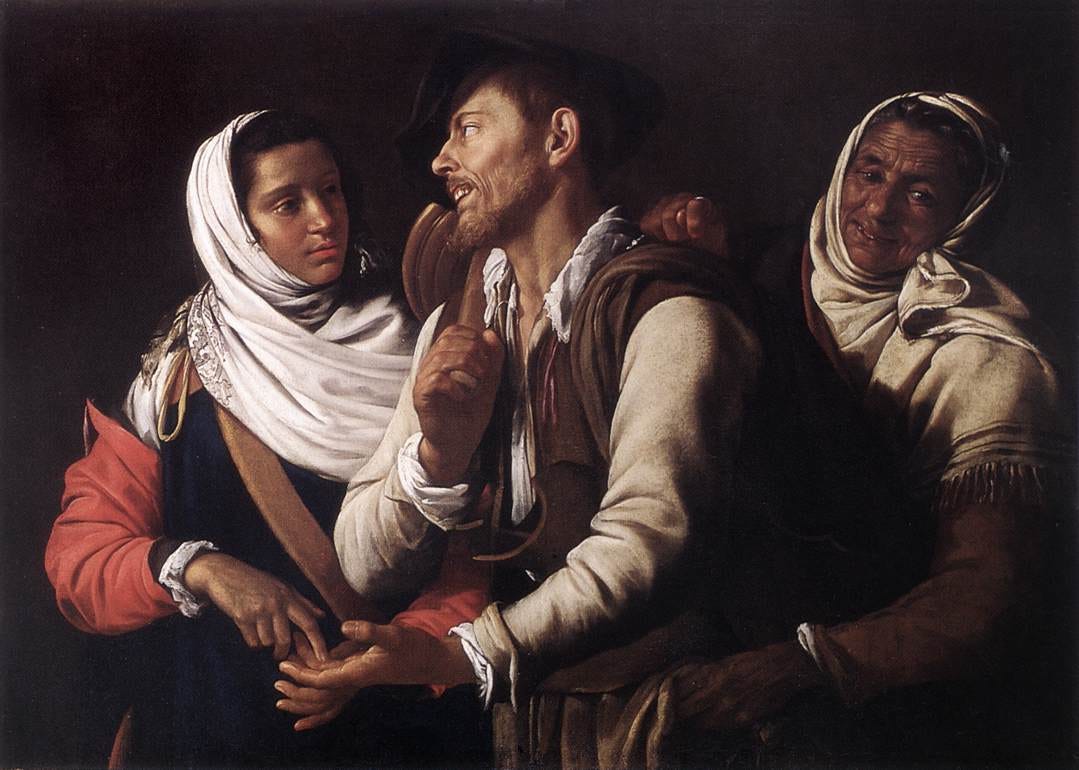
There’s a 1617 painting by Simon Vouet, hanging in Palazzo Barberini in Rome right now, showing a fortune teller distracting a man while an accomplice picks his pocket. The hustle is older than most countries.
Let’s get into what actually matters: numbers, risks, and what to do. This is the guide I wish I could hand every student or friend who tells me they’re going to Italy and asks if they should be worried.
How bad is petty crime in Italy, really?
Let’s start with the data. Guessing is worse than knowing what you’re actually dealing with.
Rome recorded over 33,000 pickpocketing incidents in 2024, up 68% from 2019. That’s roughly 90 reported cases a day, and the real number is certainly higher.
A 2024 study found that Italy leads Europe with 478 pickpocketing mentions per million visitors at its top tourist attractions, ahead of France (251) and Spain (111). The worst spots? The Trevi Fountain, the Colosseum, and the Pantheon in Rome. The Duomo in Milan. The Uffizi area in Florence.
ISTAT, Italy’s national statistics institute, reported that nearly 14 out of every 1,000 people in Lazio (which includes Rome) fell victim to pickpockets in 2023. That’s almost triple the national average of 5 per 1,000.
In response, Italy’s interior ministry created a dedicated metro police unit, the Polmetro, and you’ll see them patrolling metro platforms in Rome, Naples, and Milan.
Influencers like Simone Cicalone have become famous for patrolling the Rome metro and confronting pickpockets on camera, with some people seeing him as a hero and others seeing him as a vigilante.
On TikTok, clips of American tourists fighting back against pickpockets have gone viral. (Spoiler: Italian law is not on their side.)
So yeah, pickpocketing is real, and it’s not going anywhere. But it’s not random. Once you see the patterns, it’s predictable.
The 25 safety tips
What follows is a mix of mindset, gear, street smarts, scam awareness, and practical travel advice. Some of these you’ll know. Some you won’t. All of them are things I tell people before they go.
Mindset
1. You’re a tourist; you’ll stand out. That’s normal.
If you’re a tourist in Rome, Florence, Milan, or Naples, you are a target. Not because you’re doing anything wrong, but because you’re distracted, you don’t know the terrain, and you’re probably on your phone more than usual.
Accepting this doesn’t mean being paranoid. It means being aware. The people who get pickpocketed are almost always the ones who assumed it wouldn’t happen to them.
2. Understand that pickpockets avoid confrontation.
This is the big one. Italian pickpockets are not muggers. (And truth be told, most often they’re not Italian either.) They don’t carry weapons to threaten you with. They don’t want a scene. Their entire business model depends on you not noticing. If you make it difficult, if your stuff is secured and you look like you know what’s going on, they’ll move on to someone easier. You don’t have to be faster than the bear. You just have to be faster than the other tourists.
3. Where you are matters.
Italy is a big country. The pickpocket problem is concentrated in a few specific areas of a few major cities: mostly central Rome, Milan, Florence, Naples, and Venice. If you’re hiking the Dolomites, eating your way through Emilia-Romagna, or exploring the Marche region, petty theft is barely a consideration.
Growing up in the Marche, I could leave belongings in my car without thinking twice. Where I live now in Canada, I can’t.
A student of mine spent two weeks in Lecce and Matera and despite the south’s reputation she never once felt unsafe. Because she wasn’t. Those places don’t have the tourist density that creates conditions for organized pickpocketing.
This is also why I encourage people to visit the real Italy, outside of tourist areas, to relax and experience the beauty and slower pace the country has to offer.
4. Don’t let fear ruin the trip.
I’ve met people so anxious about theft they couldn’t enjoy a meal without clutching their bag to their chest with one hand. That’s not caution, that’s paranoia. Take simple precautions, internalize them until they’re automatic, then forget about it and enjoy one of the most beautiful countries on earth. This should take 30 seconds of thought a day, not ruin your trip.
Gear
5. Get an anti-theft crossbody bag, and actually use it.
If you do one thing, do this. A crossbody bag with a zip closure, worn across your front, makes pickpocketing nearly impossible without you noticing.
Pacsafe makes excellent options (the GO Crossbody Citysafe or the Metrosafe series are popular for a reason, including features such as: locking zippers, cut-proof straps, RFID blocking).

You don’t need to spend a fortune; any bag that crosses your body and zips shut will do.
The key is wearing it in front of you in crowded areas, not dangling behind your hip. Once it’s in the front, with your hands resting on the zipper, it becomes virtually impossible to pick pocket you. They’ll certainly opt for an easier target.
Never wear a backpack on your back in crowded places.
6. Use a money belt for the stuff you can’t afford to lose.
I know, I know. Money belts are not glamorous. But a slim under-clothing belt (Pacsafe Coversafe, Eagle Creek, PeakGear or similar) is the right place for your backup credit card, your passport in a small zip lock bag (or a photocopy), and a small amount of emergency cash (euros of course).

You don’t access it in public. Never. Only in a private bathroom stall. But it’s insurance for getting out of a jam and it only costs twenty dollars.
7. Leave the fancy jewelry at home.
This isn’t about style. If you’re wearing a Rolex in Naples, you’re advertising. My fiancée has a gorgeous engagement ring. It doesn’t come with us when we visit Italy.
The same goes for flashy necklaces, expensive sunglasses, or designer bags. None of these will get you mugged, but they’ll get you noticed, and getting noticed is the first step in the pickpocket’s workflow.
8. Carry a photocopy of your passport, not the original.
This one bugs me. Italy doesn’t take the pickpocket problem seriously, but they do require by law that non-EU citizens carry their passport at all times. So you’re forced to walk around with the one document you absolutely cannot afford to lose.
My suggestion, and it’s a controversial one: leave the real passport in the hotel safe. Carry a photocopy and a photo on your phone.
Italian law technically requires the original, but in practice a photocopy will usually satisfy a police check. Be nice to them and at worst they might scold you for not having the original on you.
Losing a photocopy is an inconvenience. Losing your passport will ruin your vacation.
9. Split your cash and cards.
Never carry all your money in one place. I keep a day’s worth of cash and one card in my front pocket, a backup card and some cash in my money belt, and the rest in the hotel safe. If someone gets my wallet, I lose maybe €50 and one card I can cancel in five minutes. Not great, not a disaster.
Street smarts
10. Front pockets only. Always.
Your back pockets are not storage. They are a buffet for professionals. Phone, wallet, anything of value: front pockets, always. This alone probably eliminates 80% of your risk.
11. Tether your wallet and phone.
A pickpocket’s entire job is to separate you from your stuff without you noticing. A tether makes that quite difficult.
I use a Pacsafe wallet that has a wire-reinforced strap that clips to your belt loop; even if someone gets into your front pocket, the wallet isn’t going anywhere. It’s a small measure that will further discourage pickpockets.
Do the same with your phone. Phone tether straps (the kind that loop around your wrist or you wear across your body) have become popular for good reason.
They cost $10-30, they don’t look ridiculous, and they mean that even if someone snatches your phone out of your hand on the metro, or you fumble it in a crowd, it stays attached to you.
Never leave your phone on the table at a café or restaurant either, especially in tourist areas. It takes one second for someone walking past to grab it, or for someone to lift it while they distract you with a newspaper or a board.
Same goes for your bag: don’t hang it behind your chair or leave it on the floor out of sight. Keep it on your lap or looped around your chair leg.
Your phone is now your map, your camera, your boarding pass, and your backup ID. Losing it mid-trip is arguably worse than losing your wallet.
12. Public transport is where you need to pay attention.
Pickpockets need two things: proximity and distraction. Both converge in predictable spots: getting on and off public transport, standing in line at attractions, navigating crowded piazzas, and squeezing through narrow passages near major landmarks.
A friend of mine got her phone lifted from her back pocket while going through a turnstile at a metro station. She felt absolutely nothing.
Rome’s Line A (Vatican to Spanish Steps to Termini) and Line B (Colosseum to Termini) are where most transit pickpocketing happens. Same applies to Milan’s metro near Duomo and Centrale, and Naples’ Line 1.
The moment of boarding, when everyone presses together and your attention is on getting through the door, is when you’re most vulnerable.
Keep your bag in front of you. Keep your hand on your phone. Stay alert. If you see commotion happening, you back away. You don’t investigate.
You can relax in 99.99% of Italy, but public transportation is one place to pay attention.
13. Be suspicious of unnecessary physical contact.
If someone bumps into you, spills something on you, blocks your path, or presses against you when there’s room not to, your first thought should be: where are my valuables?
Not every bump is a pickpocket, but the “accidental” jostle is one of the oldest techniques in the book. Do not let anyone get in your personal space.
Watch for women holding a jacket, large bag, umbrella or map in front of them. They use it to conceal what their hands are doing as they crowd you.
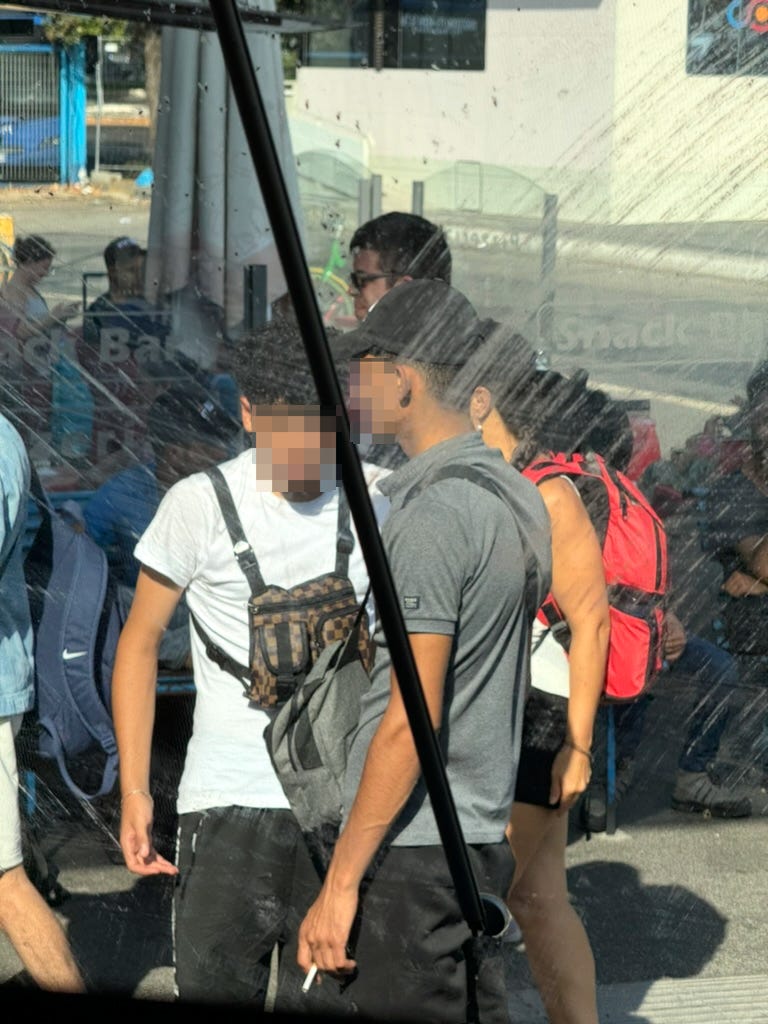
But watch out for men too. Living in North America, where pickpockets are rare, you might at times ask yourself ethical questions about judging people on the basis of their looks. You might hesitate to profile people based on appearance. That’s fair. But when someone is invading your personal space in a crowd, trust your instincts first and examine your ethics later.
14. Walk with purpose, even when you’re lost.
Pickpockets and scammers target people who look confused or hesitant. If you need to check your phone for directions, step into a shop or café. Don’t stand on a street corner squinting at Google Maps with your phone at arm’s length. You’re broadcasting both your distraction and the location of your phone.
15. Be careful around train stations at night.
During the day, major stations like Roma Termini, Milano Centrale, Napoli Centrale, and Firenze Santa Maria Novella are busy, well-patrolled, and generally fine. At night, the areas around them shift. The piazzas outside tend to attract a rougher crowd after dark: loiterers, aggressive panhandlers, the occasional drunk or dealer.
You’re unlikely to be attacked, but it’s not unheard of. What is certain is that you’re in prime territory for opportunistic theft, aggressive scams, sexual harassment, or just a very unpleasant interaction.
If you’re arriving late, take an official taxi or Uber from the station rather than walking. If you do walk, stick to well-lit streets and move like you know where you’re going (see tip 14).
If you’re waiting for a connection on a quiet platform late at night, keep your bags close and stay near other passengers or station staff.
Common scams and how to shut them down
16. The friendship bracelet.
This one is everywhere: Rome (especially near the Spanish Steps, Piazza Navona, and the Colosseum), Florence, and Venice.
A man approaches you smiling, asks where you’re from, and before you’ve finished answering, he’s tying a woven bracelet onto your wrist. Once it’s on, the smile disappears and he demands €10–20.
If you refuse, they get aggressive fast or start accusing you of being racist. Sometimes it’s a distraction while an accomplice goes for your pockets.
The fix: Don’t stop. Don’t engage. Keep your hands in your pockets or at your sides. A firm “No, grazie” without breaking stride. You are not being rude. You are being targeted.
17. The gladiator photo.
Outside the Colosseum, men dressed as Roman gladiators pose for photos with you, sometimes jumping into your selfie uninvited. Then they demand €20–50. Refuse and they get aggressive.
What they’re doing is illegal in Italy, but they do it anyway.
The fix: Don’t take photos with them. If one jumps into your shot, walk away. Don’t negotiate.
18. The petition/clipboard scam.
Groups of young people, often teenagers, approach with a clipboard asking you to sign a petition for a “deaf-mute charity” or some other seemingly worthwhile cause.
While your hands are busy with the clipboard and pen, an accomplice picks your pockets. Or after you sign, they demand a “donation.”
The fix: Never accept a clipboard from a stranger. Say no and keep walking. If you don’t feel rude, you’re not being firm enough.
19. The fake police.
Someone claims to be plainclothes police and asks to check your wallet for “counterfeit bills.” This is always a scam. Real Italian police will never ask to inspect your wallet on the street. They might ask for ID but that’s it.
(Also, this isn’t Tijuana, Mexico. Do not attempt to bribe the Italian police. It’s a serious crime in Italy.)
The fix: Ask to see identification. Tell them you’d prefer to walk to the nearest Questura (police station) together. They’ll disappear immediately.
You may also run into fake controllori (ticket inspectors) on trains. These are harder to spot, since real inspectors do board and check tickets. If something feels off, ask for credentials, show your ticket but nothing else, and never hand over cash or your wallet.
20. The “you stepped on my painting” scam.
In Florence especially (but also Rome), vendors display art prints on the ground near busy walkways along the Uffizi or Ponte Vecchio. The prints are placed so it’s nearly impossible not to step on one in a crowd. The moment your shoe grazes a print, the vendor erupts: you’ve “damaged” their artwork and owe €50, €100, sometimes more. It’s theater. The print was worthless.
The fix: Watch your step near ground-level merchandise, but if it happens, you owe nothing. Walk away. Don’t negotiate, don’t let a crowd pressure you, don’t hand over money. If the vendor gets aggressive, look for a police officer or Carabiniere. They’re usually nearby and they know exactly what’s going on.
21. The restaurant tourist trap.
Not a street scam, but it catches tourists constantly. Restaurants near major attractions (the Pantheon in Rome, San Marco in Venice, the Duomo in Florence) are notorious for hidden charges: unlisted coperto (cover charge), fish priced by weight but presented as a flat price, bread and water you didn’t order but get charged for, mediocre food charged at 3-4 times the going rate, etc.
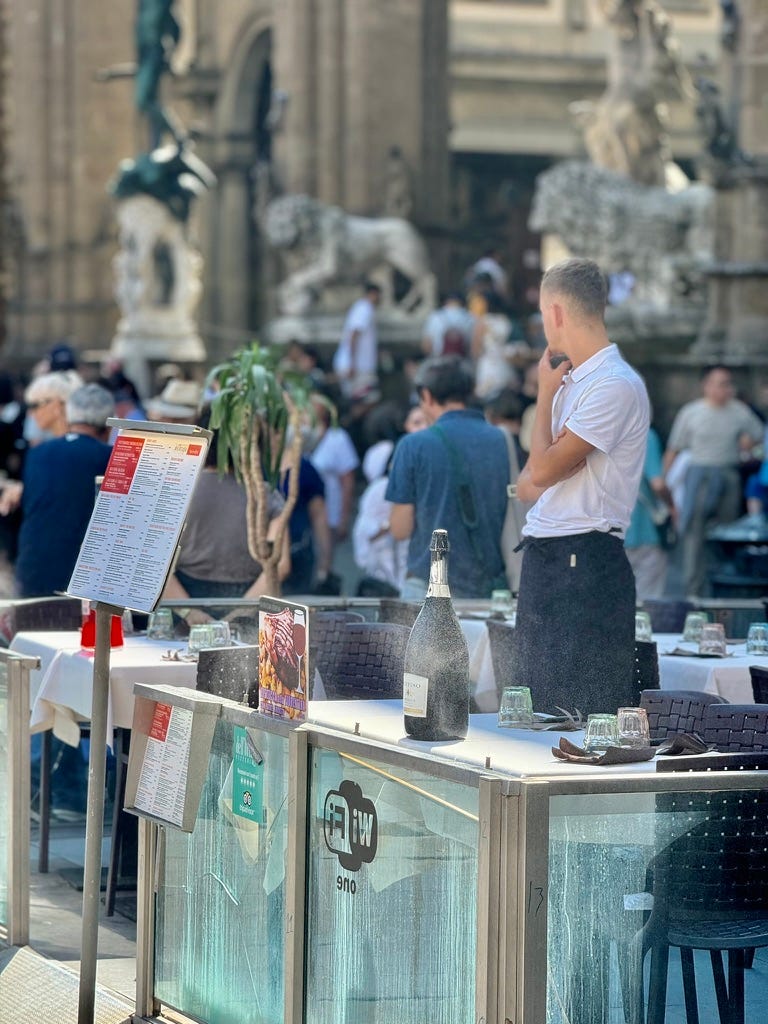
The fix: Always ask for a menu with prices. Check if coperto and servizio (service charge) are listed. Avoid restaurants where a host pulls you in from the sidewalk, where there are photos of food on the menu, or where signs in five languages advertise “tourist menus.”
As a rule, the further you walk from the landmark, the better and cheaper you eat. Look for places where Italians are actually sitting down. Check Google Maps reviews but filter for locals, not tourists.
A restaurant packed at 1 PM with Italian families is a good sign. One that’s full at 6 PM with tourists is a red flag: Italians don’t eat dinner until 8 PM as a general rule.
Also check out what to order in Italy, depending on which region you’re travelling to.
22. The taxi overcharge.
Not all taxi drivers do this, but enough do. The meter is “broken.” The route is mysteriously scenic. A fake night surcharge appears during the day. Or you pay with a €50 note and the driver claims you gave him a €10.
Watch out also for random people offering you a taxi service at the airport. They are likely unauthorized and more likely to scam you.
The fix: Use FreeNow (or ItTaxi) to book taxis, which locks in the fare. If you hail a cab, insist on the meter. Consider Uber if you’re booking in advance. Know the fixed-rate fares from airports (€50–55 flat from Fiumicino to central Rome is the official rate; anyone quoting higher is trying it on). Keep your large bills separated so there’s no sleight of hand.
23. The helpful stranger at the ticket machine.
At train stations, someone offers to “help” you buy a ticket. They’re going to pickpocket you during the transaction, charge you for the help, or both.
The fix: If you need help, ask a uniformed staff member or even safer, go to the ticket counter. Trenitalia and Italo machines are straightforward and most have English options.
Practical travel tips
24. Validate your train ticket (or risk a fine).
Not a scam, but it catches first-time visitors off guard. If you buy a paper ticket from a machine or counter for a regional train, you must validate it before boarding by stamping it in one of the small green-and-white machines on the platform. An unvalidated ticket is treated as no ticket at all, and the fine starts at around €50 on the spot.
This doesn’t apply to tickets bought online with a seat reservation (Frecciarossa, Italo), which are tied to a specific departure. But for regional and local trains where the ticket has no date and time printed on it, validation is mandatory. Miss this step and you’ll have an awkward and expensive conversation with the inspector.
25. Get travel insurance. Seriously.
The least exciting tip on the list and the one you’ll be most grateful for if things go sideways. A good policy covers stolen belongings, trip cancellations, medical emergencies (which can be expensive even in countries with public healthcare), and the bureaucratic nightmare of replacing a stolen passport mid-trip.
You don’t need the gold-plated plan. A basic policy will run you €30–80 for a two-week trip. That’s the cost of one tourist-trap dinner near the Pantheon, except this one actually protects you. Also check what coverage your credit card and employer insurance already provide.
Bonus tips
Download offline maps and key apps before you go.
Half the vulnerability tips in this guide come down to one thing: don’t stand around looking lost with your phone out. The fix is having everything available offline. Download your destination cities in Google Maps or Apple Maps before you leave. Install Trenitalia and Italo for buying train tickets without approaching those machines (see tip 23). Get FreeNow or ItTaxi so you never haggle with a cab driver.
And download WhatsApp if you don’t have it. In Italy it’s not just a messaging app, it’s infrastructure. Restaurants take reservations on it, small hotels communicate through it, and your Airbnb host will almost certainly message you there instead of email.
Learn five Italian phrases that can get you out of trouble.
You don’t need to speak Italian to visit Italy, but a handful of phrases delivered with confidence will shut down a scam faster than any amount of awkward smiling. The essentials: “No, grazie” (no thank you), your all-purpose answer. “Non mi interessa” (I’m not interested), for when they persist. “Mi lasci in pace” (leave me alone), when firm needs to become blunt. “Chiamo la polizia” (I’m calling the police), the nuclear option, rarely needed but good to have.
And “Quanto costa?” (how much does it cost?), not a safety phrase exactly, but asking the price before you touch, eat, or sit down prevents a lot of the scams in this guide.
If you catch a pickpocket in the act, don’t be a hero.
It happens: you feel a hand in your pocket, you spot someone unzipping your bag, something feels wrong mid-crowd. Your instinct will be to grab, chase, or confront. Don’t. These people work in groups, and a confrontation can escalate fast, especially in a foreign country where you don’t speak the language and don’t know the terrain.
Instead, make noise. A loud “Attenzione!”, “Borseggiatore!” (male pickpocket), “Borseggiatrice!” (female pickpocket), or simply “Ladro!” / “Ladra!” (thief) will draw attention, which is the one thing pickpockets can’t afford.
Secure your belongings, step away, and alert the nearest officer. Your property isn’t worth a physical altercation. The law is not on your side if you beat them up. And your safety is worth more than your wallet.
Get an eSIM for data.
Fumbling with local SIM cards at the airport or hunting for Wi-Fi every time you need to check a map is a solved problem. An eSIM like Airalo lets you buy a data plan for Italy (or all of Europe) before you even board the plane, and activate it the moment you land.
I use Airalo it just works; you pick your destination, choose a data package, scan a QR code, and you’re online. Having reliable data from the moment you arrive means your offline maps have a backup, your taxi apps work, your WhatsApp is connected, and you’re never stuck without Google Translate when you need it.
Plans start at a few euros for short trips. Set it up the night before you fly and forget about it. (Use the coupon code ANTONI0257 for $4.50 CAD OFF.)
You don’t need to tip in Italy.
Do not tip. In Italy, it’s not a thing. You can leave one or two euros if you really liked the service, but do not leave a 15–20% tip like you would in North America. You’d be helping to import a tipping culture that Italy doesn’t need. If a waiter demands a tip, you’re unfortunately dining at a tourist trap.
City-by-city notes
The tips above apply everywhere touristy in Italy. But the risks are concentrated in a handful of cities, so here’s what to know about each one.
Rome: treat it like the capital of pickpocketing, because it is.
Highest-risk zones: the metro (Lines A and B), Termini station, the Colosseum and Roman Forum, the Trevi Fountain, Piazza Navona, the Spanish Steps, and the Vatican queue. Be alert in these places and relaxed everywhere else. Trastevere, Testaccio, the Aventine, Monti: these neighborhoods are far calmer and, incidentally, where the best food is. Rome is enormous and most of it is perfectly safe. The danger zone is the tourist circuit, and even there, it’s manageable with basic awareness.
Florence: watch the Duomo area and the bridges.
Piazza del Duomo is ground zero. The Ponte Vecchio, with its narrow packed walkway, is another hotspot. The leather market at San Lorenzo attracts both tourists and pickpockets. And as mentioned above, the art print scam near the Uffizi (vendors lay prints on the ground and demand money if you step on one) is a Florentine specialty.
Milan: the Duomo metro station and Centrale.
Milan’s pickpocketing is concentrated around Piazza del Duomo (the square and the metro station) and Milano Centrale, one of Italy’s busiest train stations. The city has the highest overall crime rate per capita in Italy (69.7 reported crimes per 1,000 residents in 2024), though most of that is non-violent property crime. Outside the Duomo area, Milan feels more like a working city than a tourist trap, and the risk drops fast.
Naples: different rules.
Naples has a reputation that is, in my experience, about 70% outdated and 30% earned. The city is rougher around the edges than Rome or Florence, but also more authentic, more generous, and more alive.
Pickpocketing exists, especially around Napoli Centrale, Piazza Municipio, and on the metro, but the rate is actually lower than Rome’s (3 per 1,000 in Campania versus 14 per 1,000 in Lazio). What Naples has more of is motorbike bag-snatching (scippatori), which is rare but real. Wear your bag crossbody, keep it on the building side of the sidewalk (not the road side), and don’t dangle your phone while walking along busy streets. The scams in Naples can also get creative. Use your common sense.
Venice: crowded and expensive, but not dangerous.
Venice’s biggest safety issue isn’t pickpocketing in the traditional sense. It’s the sheer density of tourists funneled through impossibly narrow calli (alleyways) and onto packed vaporetti (water buses). The areas around Piazza San Marco, the Rialto Bridge, and the vaporetto stops are where pickpockets operate, using the same crush-and-grab techniques as in the Rome metro. The friendship bracelet scam is active near San Marco too.
But the real Venice “scam” is economic: restaurants in the San Marco area charge eye-watering prices, and a gondola ride costs €80–120 for about 30 minutes. None of it is illegal, just expensive. Walk ten minutes in any direction from San Marco and you’ll find quieter neighborhoods, better food, and lower prices. Cannaregio, Dorsoduro, and Castello are all more authentic and far less picked-over, in every sense.
What to do if it happens anyway
Don’t panic. You’re not in danger. You’ve lost property.
Go to the nearest police station (Questura or Commissariato) and file a report (denuncia). You’ll need it for insurance claims and to replace stolen documents. If you’re near a major monument, look for Carabinieri or police patrols. They’re almost always nearby and can direct you.
Cancel your cards immediately. If your passport was stolen, contact your country’s nearest embassy or consulate. If you followed tip 6 and have a backup card in your money belt, you’ll be back on your feet in hours, not days.
The emotional sting fades faster than you’d think. I know several people who were pickpocketed in Italy and still call it one of the best trips they’ve ever taken. Because it was. A lost wallet is an inconvenience. A trip to Italy is something you carry with you.
The bottom line
Italy’s biggest tourist cities have a pickpocketing problem. It’s real and documented. But it’s entirely manageable with basic precautions that take two minutes to adopt and quickly become second nature.
The far greater risk is letting fear keep you from going, or worse, going but spending the whole trip clutching your bag instead of looking up at the ceiling of the Sistine Chapel, wandering through the backstreets of Naples, or sitting in a piazza in the late afternoon doing absolutely nothing.
Italy is one of the safest, most welcoming, most extraordinary places you can visit. Go. Eat the carbonara (in Rome, obviously). Wear the crossbody bag. And stop reading Reddit threads at 2 AM.
You’ll be fine.
If you want to go beyond pointing at menus while you’re there, try my adaptive quizzes website, which teaches you Italian as you practice.