

How to Read an Italian Property Listing
Italian listings pack strange vocabulary and concepts with no English equivalent. Here’s what trilocali, vani, nuda proprietà, and aste actually mean.

Italian property listings are written in two languages: Italian, and real estate Italian. You need a translator for both.
The first is learnable. Once you know that a trilocale has two bedrooms (not three), that “da ristrutturare” is a polite way of saying “budget twice what you’re thinking,” and that a classe G energy rating is about to become a legal liability, you’re already ahead of most foreigners browsing immobiliare.it or idealista.it.
The second language requires understanding concepts that don’t exist in North American real estate at all. Nuda proprietà, aste giudiziarie, the caparra; these aren’t translation problems. They’re system differences.
This guide covers both.
How Italian Properties Are Actually Counted
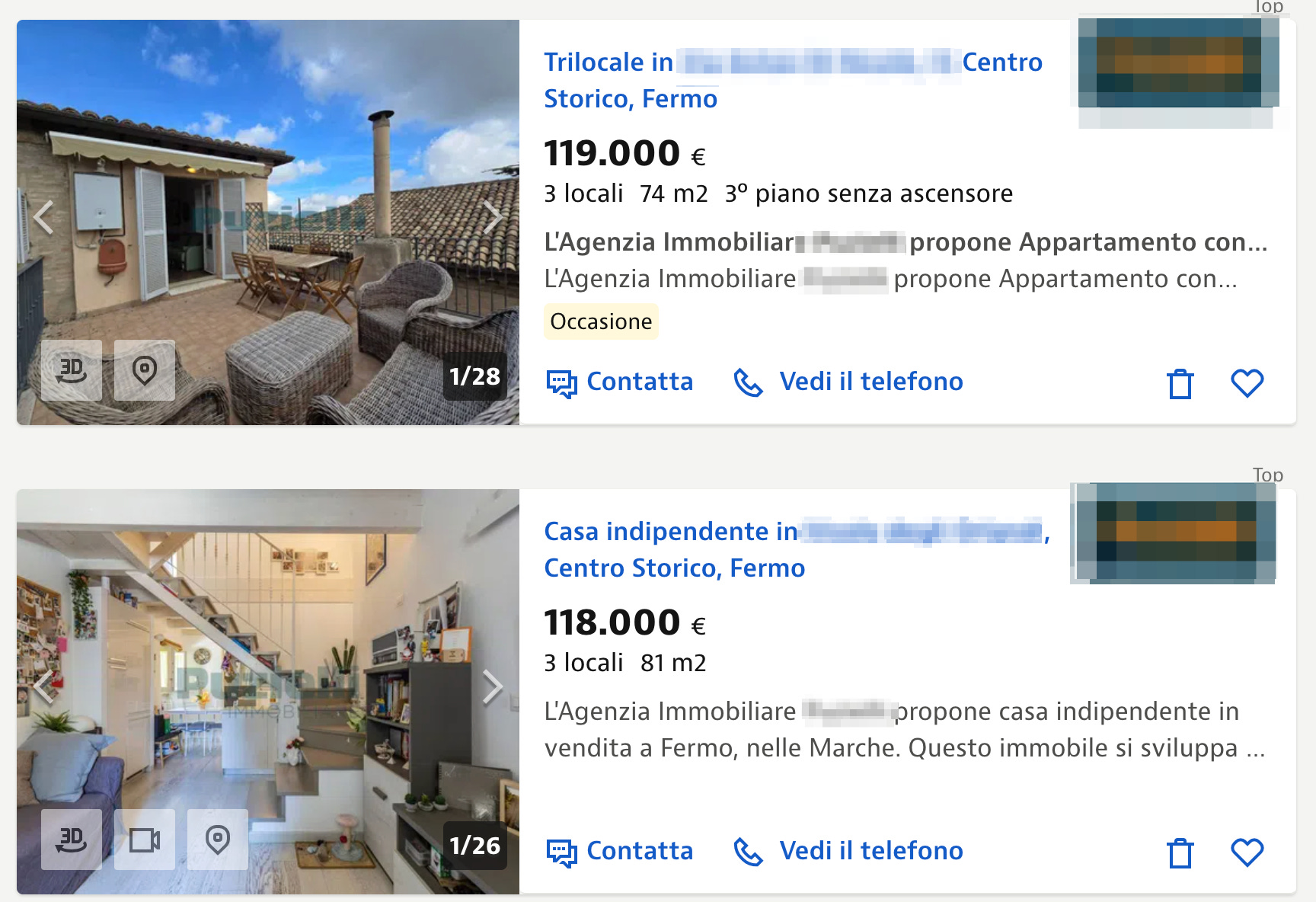
Let’s start with the vocabulary that confuses people as soon as they open a listing.
The -locale system:
A monolocale is a studio apartment.
A bilocale is a one-bedroom apartment. Unlike listings in North America, the living room counts as one of the rooms. Plus kitchen and bathroom, of course.
A trilocale has two bedrooms.
A quadrilocale has three.
The confusion comes from “trilocale” having “tri” in it, which means three. So you expect it to have three bedrooms but it doesn’t, because the living room is counted in that total. If an Italian tells you they live in a trilocale, picture what an American would call a two-bedroom apartment.
Alongside the -locale name, every listing shows a vani count.
A vano (literally a “compartment” or “unit”) is a cadastral measure from Italy’s land registry, the catasto. Not a room count. Main rooms like bedrooms and living rooms each count as one vano. A kitchen also registers as one. Bathrooms, corridors, and balconies contribute fractions.
So “trilocale, 4 vani” means a two-bedroom apartment whose spaces add up to four cadastral units. Focus on locali and number of bagni (bathrooms) rather than vani.
Want to actually learn Italian? Practice on my site: Linguetto.com.
Superficie Commerciale vs. Superficie Calpestabile
This is the single most misunderstood number in Italian listings, and it trips up almost every foreign buyer.
Superficie commerciale is the figure you see advertised. It includes the actual floor area of the apartment/house plus a percentage of walls, balconies, terraces, cantina (cellar), and sometimes a share of common spaces. It’s the “marketing” number.
Superficie calpestabile is the actual walkable floor space inside the apartment. The area you can physically stand on. This is the real number.
The difference between the two is typically 15-25%. An apartment listed at 100 sqm commerciale might only have 75-85 sqm of actual livable space. Ask for the calpestabile figure. Some agents will provide it readily; others will need to pull it from the planimetria catastale (the official floor plan registered with the catasto).
If you need to convert square meters in listings to square feet, multiply the number by 10.76 (since 1 square meter = 10.76 square feet). For quick mental math, you can simply multiply by 10 or 11. So a 100 sqm apartment is roughly equivalent to 1000-1100 square feet.
Property Types

Italian listings can use terms that don’t map cleanly to English. Below are common terms (some obvious some much less so):
Vendita means that the property is for sale. Affitto means that it is for rent.
Appartamento is any apartment or flat, regardless of size.
Attico is a penthouse or top-floor apartment, usually with a terrace. Commands a premium, but also means higher heating costs (top floors lose more heat) and potential roof maintenance responsibilities shared through the condominium.
Mansarda is an attic apartment with sloped ceilings. These can be charming, but check the altezza minima (minimum ceiling height). Italian building codes require a minimum average height of 2.70m for habitable rooms in most regions (some allow 2.40m). Parts of a mansarda that fall below this threshold may not count toward the official livable area, even if you can physically use the space.
Villetta a schiera is a townhouse or row house. Shared walls with neighbors, but typically with a small private garden.
Casa indipendente is a detached home.
Villa is a detached home, often with its own land or garden.
Unifamiliare is a single-family home, which can overlap with villa but sometimes refers to more modest detached properties.
Casale is a rural farmhouse, common in Tuscany, Umbria, Marche, and Puglia. Often sold da ristrutturare. Renovation scope on these can be enormous.
Rustico is similar to casale but usually refers to a smaller rural structure, sometimes a converted barn or outbuilding.
Buying an Apartment in a Casale
If you see a listing described as an apartment but the photos show a large casale in the hills, you are typically buying a single unit within the property. Think of it as a duplex, triplex, or fourplex (or larger multi-unit building) in a scenic countryside setting rather than suburbia.
Don't assume you're getting the entire property for around 150,000 euros. These conversions are common in rural Italy, where historic farmhouses have been legally divided into multiple residential units, each with its own deed.
Always verify the exact square meterage, which specific portions of the building and land are included, and how common areas are shared.
Building and Floor Details
Piano terra is the ground floor. In Italy, this often means potential humidity and damp issues, especially in older buildings. They are also more subject to break ins, though Italy is generally safe. Ground-floor apartments also tend to have lower resale value and less natural light. Not always a problem, but worth investigating.
Piano rialzato is a raised ground floor, slightly elevated above street level. A meaningful step up from piano terra in terms of damp risk and security.
Primo piano, secondo piano, terzo piano are the first, second, and third floors. Note that in Italy (as in most of Europe), the “first floor” is one level above the ground floor, not at street level.
Ultimo piano is the top floor. Great light, but see the mansarda and attico notes above.
Ascensore means the building has an elevator. Its absence matters more than you’d think. A fourth-floor walk-up in a palazzo d’epoca with 3.5-meter ceilings means climbing the equivalent of five or six North American flights of stairs. Every single day. With groceries.
Portineria means the building has a concierge or doorman service. Convenient for package deliveries and building security, but it significantly increases the spese condominiali (monthly condominium fees).
Posto auto is a (typically outdoor) parking space. In cities like Milan, Rome, or Florence, parking can be sold separately from the apartment and can add tens of thousands of euros to the total cost. Some listings include it, many don't. Always ask. And of course, you already know what a garage is, though it might also be referred to as a box (or box auto) in Italian listings.
Cantina is a cellar or storage room, usually in the basement of the building. Common in older properties. Useful, but check for damp.
Soffitta is an attic storage space, distinct from a mansarda (which is a livable attic apartment).
Soppalco is a mezzanine or loft level within the apartment. Attractive for extra space, but sometimes not counted in the official square footage.
What “Condition” Means in Italian Listings
Condition descriptions are honest… up to a point.
Ottimo stato (excellent condition): take it at face value. Someone spent money recently. You’ll also find recentemente ristrutturato/a (recently renovated) which typically means the apartment or house looks fairly new and modern inside.
Buone condizioni (good condition): usually accurate. Maybe some tired finishes, nothing that breaks the bank.
Abitabile (habitable): this is where the hedging starts. Abitabile means the property legally meets minimum standards to be occupied. It doesn’t mean you’d want to move in tomorrow. Old plumbing, appliances from 1987, a bathroom untouched since the previous owner’s grandmother married. All technically abitabile.
Da ristrutturare (to be renovated): the listing is telling you the truth, but possibly understating the scale of the project. In Marche or Umbria, where labor is cheaper and contractors are easier to find, this might mean a manageable renovation. In a historic palazzo in Rome, Florence, or other major art cities, it can mean a multi-year process involving the local heritage office. In some areas of the south, particularly rural locations, you might struggle to find reliable contractors with availability, though this has improved in recent years.
Stato originale (original condition): nothing has been touched since the property was built or last seriously renovated. Could be 50 years ago. Romanticized in listings. It isn’t romantic.
Real Estate Agent Vocabulary

Then there’s the common vocabulary agents use to describe a property’s surroundings and character:
Palazzo d'epoca (historic building): this means the building is old and has architectural character, often with high ceilings, ornate facades, and period details. But it also means renovation restrictions will likely apply, especially if the building is under the oversight of the Soprintendenza (the Italian governmental body responsible for protecting cultural and architectural heritage).
Signorile (elegant, refined): the building has a certain prestige. Expect marble staircases, a portineria, and higher condominium fees. Wealthier families live here.
Zona animata (lively area): it’s loud right outside the place.
Zona emergente (up-and-coming): not currently desirable, and the timeline for improvement is anyone’s guess. Think of it as “developing.”
Ben collegata (well-connected): there’s a major road or railway close by. This can also genuinely mean good public transit access, which in Italian cities is a real advantage. Context matters: ben collegata in central Milan probably means excellent metro and tram service; ben collegata in a rural area likely just means an autostrada (motorway) nearby.
Luminoso (bright): usually means good natural light and favorable exposure. South-facing apartments in Italy are prized.
Silenzioso (quiet): often signals an internal courtyard-facing apartment, which trades street noise for less direct sunlight.
Vista aperta (open view): no building directly blocking the windows. Genuinely valuable and relatively rare in dense Italian city centers.
Immersa nel verde (immersed in greenery): often this means in the middle of nowhere.
Termoautonomo (autonomous heating): more on this below, but when you see it in the listing summary, it’s a selling point.
Legal and Administrative Terms in Listings
As you look up listings, you might also see a bunch of legal terms. Understanding them saves you from unpleasant surprises:
Catasto is Italy’s land registry, maintained by the Agenzia delle Entrate (the Italian tax authority). Every property has a cadastral record that includes its official category, size in vani, etc.
Rendita catastale (cadastral income) is the tax-base value assigned to the property by the catasto. It is not the market value and is almost always much lower. It is used to calculate property taxes (IMU, TASI), registration tax at purchase, and other fiscal obligations.
APE (Attestato di Prestazione Energetica) is the energy performance certificate. Every property listed for sale or rent must have one. It’s the document that assigns the classe energetica (energy class) rating.
Certificato di agibilità (habitability certificate) confirms that the property meets safety, hygiene, and energy standards required for legal occupancy. Not every older property has one, and its absence can complicate a sale. Ask your notaio (notary) to verify it exists.
Concessione edilizia (building permit): relevant if the property has been expanded, modified, or if an extension was built. Unauthorized building work (abuso edilizio) is more common in Italy than you might expect, and it can block a sale or create legal headaches down the road.
Proposta d’acquisto (purchase offer): the formal written offer you submit to the seller through the agent. This is the step before the compromesso (the preliminary sale agreement). Once the seller accepts it, the proposta becomes legally binding. Money is typically attached. Do not sign one without understanding that it commits you.
Provvigione (agent commission): in Italy, both the buyer and the seller typically pay the agent a commission, usually 2-5% each. This is a shock for North Americans used to the seller covering the full commission. Budget for it. It’s negotiable in theory, less so in practice, especially in hot markets.
Imposta di registro (registration tax): the tax paid at purchase when buying from a private seller (not a developer). For a primary residence (prima casa), it’s 2% of the rendita catastale (with a minimum of EUR 1,000). For a second home, it’s 9%. When buying new construction from a builder, you pay IVA (VAT) instead, at 4% for prima casa or 10% for second homes, calculated on the purchase price rather than the cadastral value.
The Energy Class Problem Every Foreign Buyer Ignores
Every Italian listing now should include a classe energetica, running from A4 at the top to G at the bottom. Most older properties in Italy land somewhere between E and G.
This used to be a footnote. It isn’t anymore. The EU’s Energy Performance of Buildings Directive requires all Italian residential properties to reach at least class E by 2030 and class D by 2033. Italy has accepted these targets. A class F or G property isn’t just expensive to heat. It’s a depreciating asset with a legal renovation requirement attached to it.
When you see “cl. en. G” in a listing and the price looks attractive, run the numbers first. Bringing an older apartment up to class D can cost EUR 20,000 to EUR 80,000 or more, depending on what needs doing: new insulation, window replacement, full heating system overhaul.
That’s before whatever other renovation you already planned. The bargain might still be a bargain. Or it might not.
Centralizzato vs. Termoautonomo: The Heating Question
Look for termoautonomo (autonomous heating) in listings. It means the apartment has its own independent boiler, which you control and pay for directly. This is what you want.
Centralizzato (centralized heating), in the context of aparments, means the building shares a single system managed by the condominio, the building’s governing body (roughly an HOA or strata). You pay a fixed monthly share regardless of how much heat you actually use. If your neighbors run the heat at 22°C/72°F all winter while you’re abroad for three months, you’re still splitting the bill. Some buildings with centralizzato have since added individual metering systems. Ask specifically.
On that note: every listing should show spese condominiali (condominium fees), the monthly charge covering shared building costs: insurance, elevator maintenance, cleaning, and ongoing repairs. EUR 100-200/month is standard for a basic apartment. Detached houses do not typically have such an expense.
Old buildings with doormen (portinai), ornate facades under restoration, or recent elevator installations can run EUR 400-600/month or more. Before signing anything, request the verbale dell’assemblea condominiale, the minutes from the most recent building meeting, to see what major expenses are planned or already approved.
The Concepts With No English Equivalent
These are the ones that actually trip people up because they require a different mental model.
Il notaio
Italy requires a notaio (notary) for every property transaction. Not optional. The notaio is a state-appointed professional who checks the property’s legal status, verifies there are no outstanding mortgages or liens (ipoteche) registered against it, and finalizes the deed of sale, the rogito (notarial deed). Their fee should be flat and not a percentage of the purchase price. It is paid by the buyer.
The notaio is not your lawyer. They’re a neutral party ensuring the transaction is legal. Consider a separate property lawyer as well, if you’re buying as a foreigner.
Il geometra
A geometra is a licensed technical professional, roughly between a surveyor and a building technician. They handle cadastral surveys, building permits, property boundary disputes, renovation compliance checks, and the technical paperwork that connects a physical property to its legal records in the catasto.
Many foreign buyers skip hiring one and rely entirely on the notaio, which is a mistake: the notaio checks legal status, but a geometra checks that what's physically there matches what's on paper. Their fees are small relative to the problems they catch.
Caparra confirmatoria vs. Caparra penitenziale
When you sign the compromesso (the preliminary sale agreement, also called contratto preliminare di vendita), you pay a caparra (deposit), usually 20% of the price. The type matters more than most people think.
A caparra confirmatoria: if you back out without legal justification, you lose the deposit. If the seller backs out without legal justification, they must return double the deposit. However, if the buyer can prove higher losses they can sue to recover them.
A caparra penitenziale: if the contract expressly grants a right of withdrawal, known as diritto di recesso, to one or both parties, the deposit functions as the agreed price for withdrawing. If the buyer exercises this right, they lose the deposit. If the seller exercises it, they return double. No further legal claims for damages can be made.
The compromesso is legally binding once signed. Read it with a lawyer before you touch a pen.
Nuda Proprietà: Buy a Home You Can’t Live In Yet
Nuda proprietà (bare ownership) splits a property into two legal interests. You buy the title. The seller keeps the usufrutto (usufruct), the legal right to live in and use the property, typically for the rest of their life. You become the owner on paper. But you can’t move in, rent it out, or do anything with it until the usufructuary dies or the term expires.
In exchange, you pay significantly below market value. From as little as 20% to as much as 50% off, depending on the age of the seller.
The risk: they live longer than expected. It happens, and there’s no recourse. Also, Italian banks generally won’t finance nuda proprietà purchases, so you’re usually paying cash.
What’s going on here is this: an older homeowner, especially someone without kids, can improve their cash flow by selling their home while still living in it for the rest of their life.
From the seller’s perspective, this can provide much needed cash without downsizing.
From the buyer’s perspective, if there is no urgent need to move in, this can be a way to purchase a property far below its current market value.
Win win. Except sometimes things go south because the old lady that sold you the house lives to 122 and you die before she does.
Aste Giudiziarie: Italy’s Least-Known Property Discount
An asta giudiziaria (judicial auction) is a court-ordered sale of a property seized from a debtor who couldn’t pay their creditors. The tribunal sets a prezzo base (starting bid) below market value, and the property goes to the highest bidder.
Discounts of 20-40% below market are real and achievable, particularly in the south, where properties sometimes go through multiple failed auction rounds. Each failed round typically triggers a further 25% reduction to the base price. By the third or fourth round, the numbers get quite low.
These auctions are public and listed on regular real estate sites as well as platforms like astalegale.net. To participate you need a codice fiscale (Italian tax identification number), a 10% cauzione (deposit) paid via certified bank transfer before bidding, and the remaining balance settled within 60-120 days of winning.
The risk: Inspection rights are limited. You can request a visit, but it’s not guaranteed, and properties are sold as-is. Previous occupants sometimes haven’t left or they vandalized the property in frustration.
I wouldn’t recommend them. The savings are real but so are the complications and headaches.
Have you started looking at properties in Italy? What’s confused you most when reading the listings?
If you’re researching where to live in Italy or still deciding whether to make the move at all, consider my articles below:


Frequently Asked Questions
How much should I budget beyond the purchase price?
The listed price is far from the final number. For a private property purchased as a primary residence, expect to add 10-15% of the purchase price when you add in registration tax (2% of the rendita catastale, minimum EUR 1,000), notaio fees (typically EUR 2,000-4,000), agent commission (2-5% of the purchase price), geometra, and any legal fees if you hire a separate property lawyer (which you should as a foreigner). If the property needs energy class upgrades to meet EU 2030/2033 targets, add EUR 20,000-80,000 or more. If there’s renovation beyond that, budget separately.
Can I get a mortgage as a foreigner in Italy?
Yes, but the process is slower and more restrictive than for Italian residents. Italian banks will typically finance 50-60% of the property value for non-residents, compared to 70-80% for residents. You’ll need proof of income, tax returns from your home country (often translated and apostilled), and a codice fiscale. The process from application to approval can take 60-90 days or longer. Interest rates and terms vary by bank. Intesa Sanpaolo, UniCredit, and Monte dei Paschi di Siena are among the banks with the most experience lending to foreign buyers. Some buyers use mortgage brokers who specialize in non-resident applications.
What is the typical timeline from offer to keys?
The process has three main stages. First, you submit a proposta d’acquisto (purchase offer), which becomes binding once accepted. This is usually accompanied by a small earnest deposit. Within a few weeks, you sign the compromesso (preliminary contract) and pay the caparra, typically 20% of the price. The period between compromesso and rogito (final deed) is usually 60-120 days, during which legal checks, mortgage approval, and other due diligence are completed. At the rogito, signed before the notaio, you pay the balance and receive the keys. Total timeline from first offer to ownership: roughly 3-5 months, assuming no complications.
What are the biggest hidden costs in Italian real estate?
Agent commission from the buyer’s side is the one that shocks most foreigners. At 2-5% of the purchase price, it’s a significant expense that doesn’t exist in many other markets. Beyond that, spese condominiali (condominium fees) in older, well-maintained buildings can run EUR 300-600/month, far above what many buyers expect. IMU (the municipal property tax) applies to second homes and is calculated from the rendita catastale. And the EU energy compliance deadlines mean that any property rated F or G comes with a mandatory renovation cost that is essentially a hidden surcharge on the purchase price.
What does trilocale mean in Italian real estate?
A trilocale is a two-bedroom apartment. Despite the “tri” prefix, it doesn’t mean three bedrooms. Italian property counts rooms including the living room, so a trilocale has three rooms total: a living room plus two bedrooms. A quadrilocale adds a third bedroom. Always check the actual layout on the planimetria (floor plan) rather than relying on the -locale label alone, since room sizes can vary wildly.
What is nuda proprietà and is it a good investment?
Nuda proprietà (bare ownership) means buying a property’s legal title while the seller lives there until death. You pay well below market value: usually 20-50% less, depending on the seller’s age. It can be a strong long-term investment if you don’t need immediate use of the place and can pay cash, since Italian banks generally won’t mortgage bare ownership. The main risk is that the seller lives longer than expected, extending your wait with no legal recourse. There is also an opportunity cost since that capital could have been invested instead.