

How to Book Trains in Italy: The Complete 2026 Guide
Trenitalia or Italo, refunds, strikes, classes, and the booking tricks locals use. The complete guide to riding Italian trains without getting burned.

Italian trains are excellent. They don’t cost much by international standards (if you book ahead) and they truly connect the country. The rides are comfortable, relaxing, and the views can be stunning.

What is not always intuitive, especially for foreigners, is navigating how to book them, the gotchas, the occasional strikes, the scams, and so on.
In this complete guide, I’ll tell you everything you need to know about Italian trains, from someone who grew up riding them and now mostly visits them with the slightly amused eyes of a returning expat.
Trenitalia vs Italo: The Two Operators You Need to Know
Italy has two main train operators.
Trenitalia is the state-owned giant. It runs the entire regional network plus the high-speed Frecce (literally: arrows), the slower Intercity trains, and the international connections.
Italo is the private upstart, launched in 2012, the only serious private competitor. It runs only in selected cities on the high-speed network.
Italo doesn’t have as much coverage but they serve a surprisingly large portion of the most travelled routes (e.g., Naples-Rome-Florence-Bologna-Turin). They are also adding a growing list of less prominent stops.
For more offbeat areas in several regions of the south and center, Trenitalia is essentially your only option.
The differences matter. Italo trains tend to be cheaper, newer, the seats are Poltrona Frau leather even in the cheapest class, and the staff tend to be friendlier and more attentive in my experience. Trenitalia trains, particularly their Frecce, are perfectly fine, just less consistent.
As an aside, keep in mind that if you book a Trenitalia train from, say, Turin to Rome and board at Florence instead of your ticketed origin, your assigned seat may not be waiting for you.
Italo passengers are less likely to experience the issue, but both companies expect you to board at the station printed on your ticket.
Where to Book: Apps, Websites, and Third Parties
Buy directly from Trenitalia or Italo. That’s the short answer. Both have decent English-language apps and websites, both accept foreign credit cards (mostly), and both give you the cleanest refund and exchange options when something goes wrong (more on this in a moment).
The Trenitalia app is the workhorse for most Italians. It handles digital tickets, automatic check-in for regional routes, season passes, and the CartaFRECCIA loyalty program. The Italo app is sleeker but covers fewer routes as already mentioned.
Trainline and Omio are the two third-party aggregators most foreigners end up using. They’re legitimate. They’re not scams. They charge a small booking fee and they smooth out the rough edges of the Italian-language user experience.
If your card keeps getting rejected by Trenitalia or you genuinely cannot figure out which fare type to pick, use Trainline. Keep in mind that any modification or refund will route through Trainline rather than the operator, which adds a step.
Otherwise, just stick to Trenitalia/Italo directly.
Avoid the random Google ads at the top of search results. Sites with names like “italyrail-tickets.com” or “europetrains-discount.net” are usually reselling Trenitalia tickets at a markup, sometimes a steep one. There’s no need to ever pay 30% above face value for a ticket you can buy yourself in five minutes. Those are genuine scams in my opinion.
How far in advance can you book?
Trenitalia opens its high-speed fares roughly 90 to 120 days before departure. Italo follows a similar window. Don’t try to lock in a Frecciarossa from Rome to Florence six months out, because the timetable simply doesn’t exist yet.
When the schedule does open, the cheapest fares (Trenitalia’s “Super Economy”, Italo’s “Low Cost”) release in tiny batches. They’re the first to disappear. A Rome to Florence Frecciarossa booked four months out can cost as little as €15 to €20. The same train booked the morning of departure can hit €70 or €80. The earlier you commit, the more you save. There is no “secret code” or hidden discount: the system uses dynamic pricing, just like an airline.
Regional tickets are a different story. They have a fixed price regardless of when you buy them. You can walk up to any station, buy a ticket from a self-service kiosk, and ride the next train. There’s no penalty for waiting. So: book Frecce and Italo early, buy regional tickets at the same time or whenever.
Train Categories: Frecce, Intercity, and Regional
Italian trains come in roughly three speeds, and the price difference between them is significant.
Le Frecce are the high-speed flagships. There are three sub-categories:
Frecciarossa (”red arrow”) tops out at 300 km/h and runs the main high-speed lines: Turin-Milan-Bologna-Florence-Rome-Naples-Salerno, plus Venice and a few extensions. The newest Frecciarossa 1000 is the train to beat.
Frecciargento (”silver arrow”) runs at up to 250 km/h, partly on high-speed track and partly on conventional rail. It serves places like Rome to Bari, Rome to Lamezia, and Rome to Verona.
Frecciabianca (”white arrow”) is the slowest of the three, capping out around 200 km/h on conventional lines. Slowly being phased out.
Intercity is the middle tier. Slower than the Frecce, cheaper, with seat reservation included. It’s the train you take to places the Frecce skip: Reggio Calabria, Cosenza, parts of the Adriatic coast, sections of Sicily. The Intercity Notte is the overnight version, with sleeping bunks.
Regionale and Regionale Veloce are the workhorses of daily Italian life. Regionale stops at every village. Regionale Veloce skips the smaller stops and gets you there 20 to 30 percent faster on the same route, for the same price. Tickets are interchangeable. No seat reservations. Cheap, simple, sometimes slow, occasionally crowded, quite often on time when there’s no strike. If you’re going from Florence to Lucca, Naples to Sorrento, or Rome to Tivoli, you’re taking a regional train.
Ticket Classes on Trenitalia’s Frecciarossa
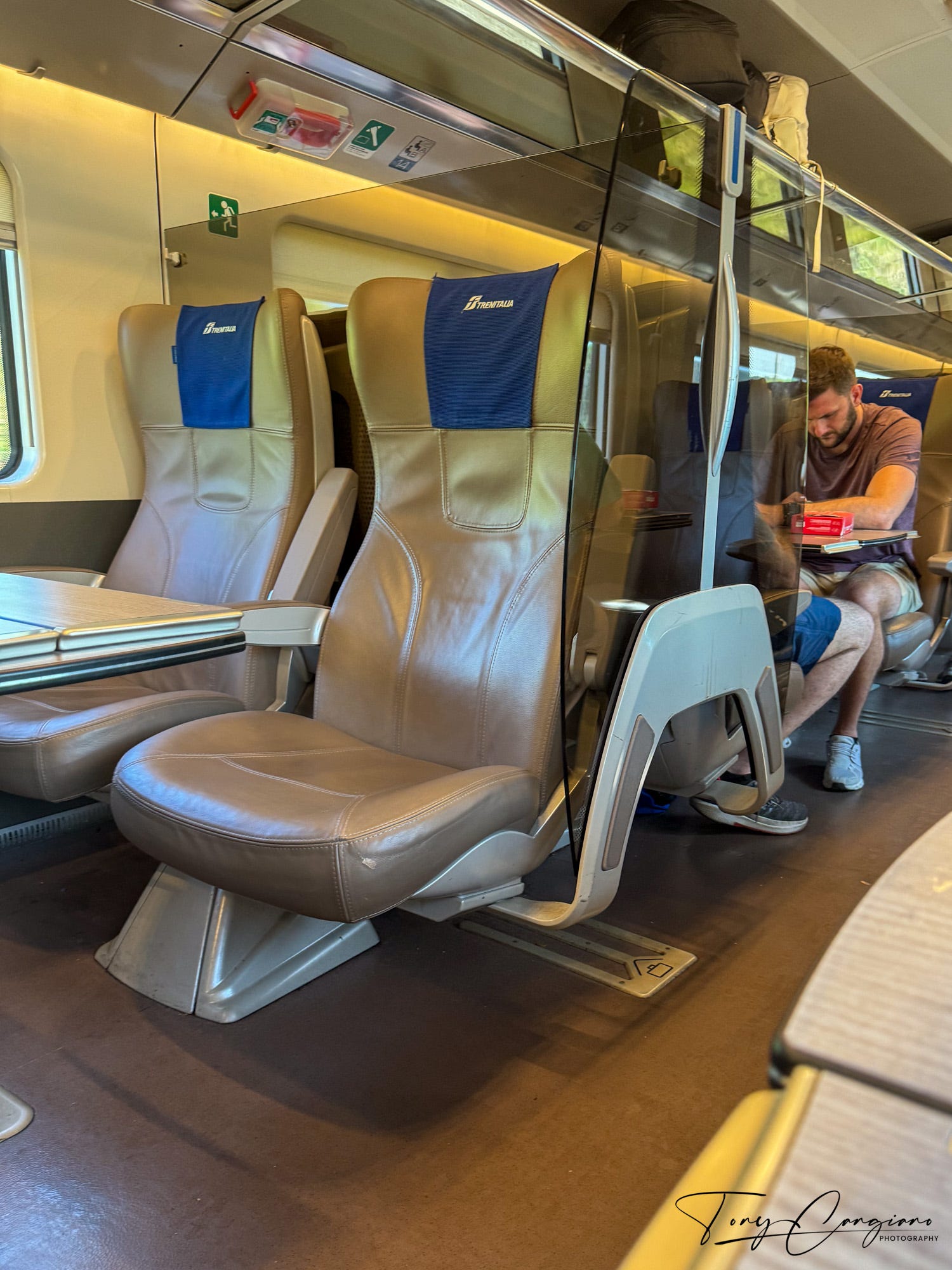
Frecciarossa has four classes, and the difference between them is bigger than most travelers assume.
Standard is the cheapest. Cloth or leather seats in a 2+2 configuration. Power outlets, free WiFi, perfectly fine for a couple of hours.
Premium gets you leather seats in the same 2+2 layout, a (poor) complimentary welcome snack-and-drink pack, and glass dividers between rows for a bit of added privacy.
Business moves to a 2+1 configuration, more legroom, reclining leather seats, a real welcome drink (coffee or prosecco), crystal privacy dividers, a quiet car option (the Area Silenzio, usually in coach 2), and at-seat service by staff.
Executive (Salottino) is the top tier. Ten seats per carriage, champagne-colored leather wider seats, served meals on real china, and complimentary access to FrecciaClub lounges at major stations up to four hours before departure. Is the upgrade worth it? Almost never on a sub-90-minute trip. Standard is fine for Rome to Florence. On Milan to Rome (just under three hours).
Business is genuinely nicer than Standard and often only €15 to €25 more if you book early. Executive is a splurge that mostly makes sense if you want to work, eat, and arrive feeling unbothered. The FrecciaClub lounge access is a real perk in Roma Termini, where the standard waiting areas can feel sketchy and a stress test.
Ticket Classes on Italo
Italo’s official class structure has three levels, though some older trains still have a Comfort section with slightly more legroom between Smart and Prima.
Smart is the base class. Reclining leather seats, 2+2, free WiFi, vending machines in the Snack Area. Roughly equivalent to Trenitalia Standard, but with better seats and carpet underfoot.
Prima (sometimes branded as Prima Business) moves to 2+1, wider leather seats, at-seat snack and drink service, and Fast Track in Rome and Milan. Fast Track lets you skip the queue at platform checkpoints. Prima is roughly comparable to Trenitalia Business.
Club Executive is Italo’s flagship. Eleven seats in an open salon plus two intimate four-seat compartments called Salotto, Poltrona Frau leather throughout, complimentary wine or prosecco served by a dedicated steward, and lounge access up to 90 minutes before departure. The expensive Salotto compartments are unreasonably enjoyable and worth booking on a long route if you can find one that doesn’t cost an arm and a leg.
My take: Italo’s Smart beats Trenitalia’s Standard. Italo’s Prima is roughly Trenitalia Business. Club Executive and Trenitalia Executive are close to a tie on comfort, and which one you prefer is mostly aesthetic. However, Italo’s Salotto is the benchmark.
Loyalty Programs: Are They Worth It?
CartaFRECCIA is Trenitalia’s free loyalty program. You earn one point per euro spent on Frecce and Intercity, half a point per euro on regional. Hit 1,000 points and you reach Silver (10 to 15% bonus points, FrecciaClub access). Hit 3,000 and you reach Gold (25% bonus points, FRECCIALounge access). Hit 7,500 and you reach Platinum (50% bonus, more perks).
Italo Più works similarly. You earn points faster on Flex fares, slower on Low Cost, and the higher tiers unlock lounge access and class upgrades.
Should you sign up? Yes, it’s free. Will it change your life? No. Even if you move to Italy, unless you’re a business commuter doing the Milan-Rome run weekly, you’ll never accumulate enough points to redeem a meaningful reward.
Discount fares almost always beat what your points are worth. Sign up so you have the account, but don’t pay extra for any “preferred” fare just to earn more points. It isn’t worth it.
Refunds, Vouchers, and the Rimborso Process
The word for refund in Italian is rimborso. The word you’ll actually get is sometimes “voucher”, which is not the same thing.
The general principle with both Trenitalia and Italo is that the cheapest fares are non-refundable and often non-changeable. If you can’t go, the money is gone, unless you purchased the optional add-on at booking, which allows for a substantial (though partial) refund.
Take the following fare options for a train from Milan to Rome:
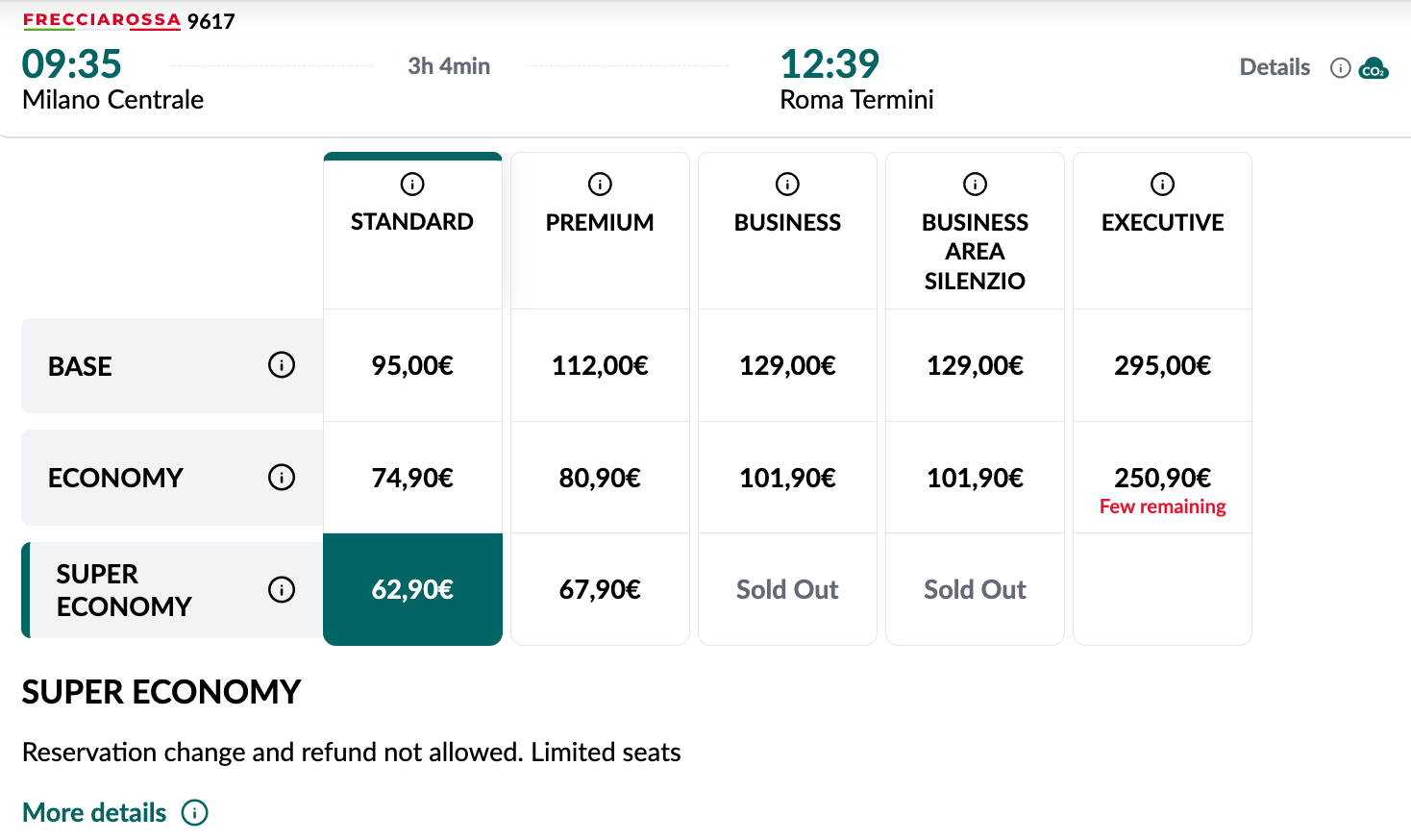
The 4 classes (Standard, Premium, Business, and Executive) can be selected in three possible reservation categories:
Super Economy: No refunds, no time changes.
Economy: No refunds, time changes accepted.
Base: Substantial, partial refunds and time changes accepted.
Now, let’s take a look at a similar trip on Italo:
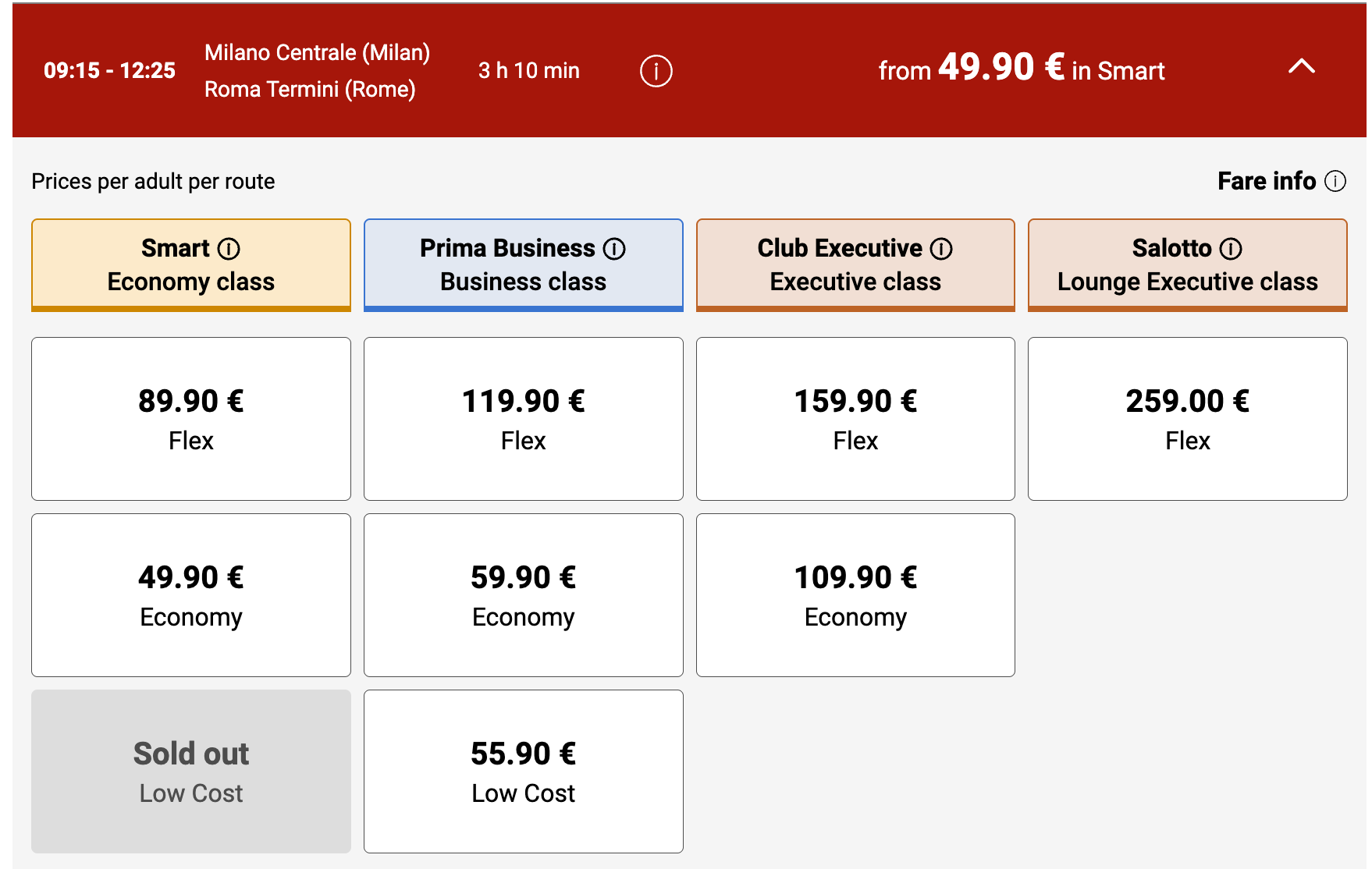
Again, you can choose between Smart, Prima Business, Club Executive, and Salotto, and then pick three possible reservation categories:
Low Cost: No refunds, changes allowed 3 days before departure for a substantial 60% fee.
Economy: 60% refunds, changes for a reasonable 20% fee.
Flex: 80% refunds, free changes.
Your plans in Italy can and will change. A ride will be delayed enough that you’ll miss your connection. I recommend you select either a fare that allows for changes and refunds or at least opt for the tiRimborso (Trenitalia) and Refund option (Italo) add-ons for a couple of extra euros.
When you cancel a refundable ticket, the default is often a credit voucher rather than money back to your card. Read the cancellation page carefully and pick the cash refund option if it’s offered, otherwise you’ll be stuck with credit you may never use. The voucher usually expires in 12 months.
For delay compensation (more on that below), Trenitalia defaults to a “bonus” you can use against future tickets. If your delay was 60 minutes or more, you can demand cash or a credit-card refund instead. They won’t volunteer this. You have to choose it.
Strikes (Sciopero) and Your Rights During Delays
Italian rail strikes happen. They’re announced in advance, they follow legally enforced rules, and they’re nowhere near as catastrophic as foreign coverage suggests. But they will ruin your day if you don’t see one coming.
Expect roughly one or two scioperi (strikes) per month somewhere in the system, usually 24 hours, sometimes shorter. National strikes are rarer but more disruptive and not unheard of.
The official calendar is published by the Italian Ministry of Infrastructure and Transport (MIT scioperi page) and Trenitalia mirrors the relevant ones on its own information page. Check before any long trip. Bookmark the MIT page.
Fasce di garanzia: the trains that still run
By Italian law, even during a strike there are guaranteed service hours called fasce di garanzia. These are typically 6:00 to 9:00 in the morning and 18:00 to 21:00 in the evening. Trains scheduled to depart, arrive, or be in transit during these windows must run.
If that train ride is critical to you, book it during those times for good measure.
Trenitalia and Italo publish lists of “guaranteed trains” (treni garantiti) on their websites the day before the strike. Find your train on that list, and you’re fine. Don’t find it, and assume it’s cancelled.
If your booked train is cancelled by a strike, you’re entitled to a full refund. Request it through the app or at the ticket office.
Delay compensation: what you’re owed
For Frecciarossa, Frecciargento, and Frecciabianca, the rules are layered. Trenitalia offers its own voluntary bonus on top of what EU law requires:
30 to 59 minutes late: 25% of the ticket price as a Trenitalia credit voucher (bonus), usable within 12 months. They are willing to refund a portion because delays past 30 minutes are not very common. The train system in Italy mostly works.
60 to 119 minutes late: 25% of the ticket price as cash, voucher, or card refund (your choice), per EU Regulation 2021/782. Applies to tickets costing at least €16. This level of wait sucks so at this point, you finally get cash instead of a voucher.
120 minutes or more: 50% as cash, voucher, or card refund. Applies to tickets costing at least €8. You have up to one year to file the claim, through the app, the website, or any biglietteria (ticket office). Thankfully this level of ritardo is fairly rare.
Italian Train Vocabulary You Actually Need
Italian train signage is mostly bilingual at major stations. At smaller ones, it isn’t. These are the words that matter.
Binario: track. Trains depart “from binario 5”.
Piattaforma: platform. Used less than binario.
Carrozza: carriage / coach. Your ticket says carrozza 7, posto 14A.
Posto: seat.
Andata: one-way.
Andata e ritorno: round-trip.
Prima classe / seconda classe: first / second class (mostly on Intercity and regional, not Frecce).
Convalida: validation of your ticket. More on when and if you need to validate your ticket, in a moment.
Biglietteria: ticket office.
Obliteratrice / Validatrice: the little machine you stamp your regional ticket in before boarding.
Coincidenza: connection.
Ritardo: delay, followed by a number in minutes.
Sciopero: strike.
Soppresso: cancelled. If you see your train marked soppresso, head straight to customer service.
In orario: on time.
Fermata: stop.
Capotreno: train manager.
Controllore: ticket inspector.
Supplemento: surcharge.
Prenotazione obbligatoria: mandatory reservation.
Posto a sedere non garantito: seat not guaranteed (typical on regional and during strike-disrupted travel).
Partenze / Arrivi: departures / arrivals.
Salita / Discesa: boarding / disembarking.
Train vs Flixbus: When the Bus Actually Wins
Italy’s love of trains is well-earned, but trains aren’t always the answer.
Take Flixbus when:
The route involves crossing the Apennines on a less-traveled axis (Naples to Bari, Rome to Pescara on certain schedules, anything across the spine of central Italy that doesn’t follow a high-speed corridor). The bus often beats the train because the train route is indirect. I often take it to go from Roma Tiburtina to Civitanova Marche.
You’re going to or within Puglia, Calabria, or Sicily, where rail service thins out and the bus has direct routes.
Your budget is tight and your schedule is loose. Naples to Rome on Flixbus can be €5 versus €25 on the train, for an extra hour.
You’re going to a smaller town that simply has no station nearby.
A train would require two or more “cambi” (train changed).
Buses are also nearly immune to rail strikes, which is occasionally a good reason to choose them.
Take the train when:
You’re on a high-speed corridor (anything from Naples to Turin via Rome, Florence, Bologna, Milan).
You have direct regional or intercity trains from point A to B with no cambi.
You get sick on winding roads.
You value not sitting in summer holiday traffic on the A1 highway.
Practical Tips for Riding Italian Trains
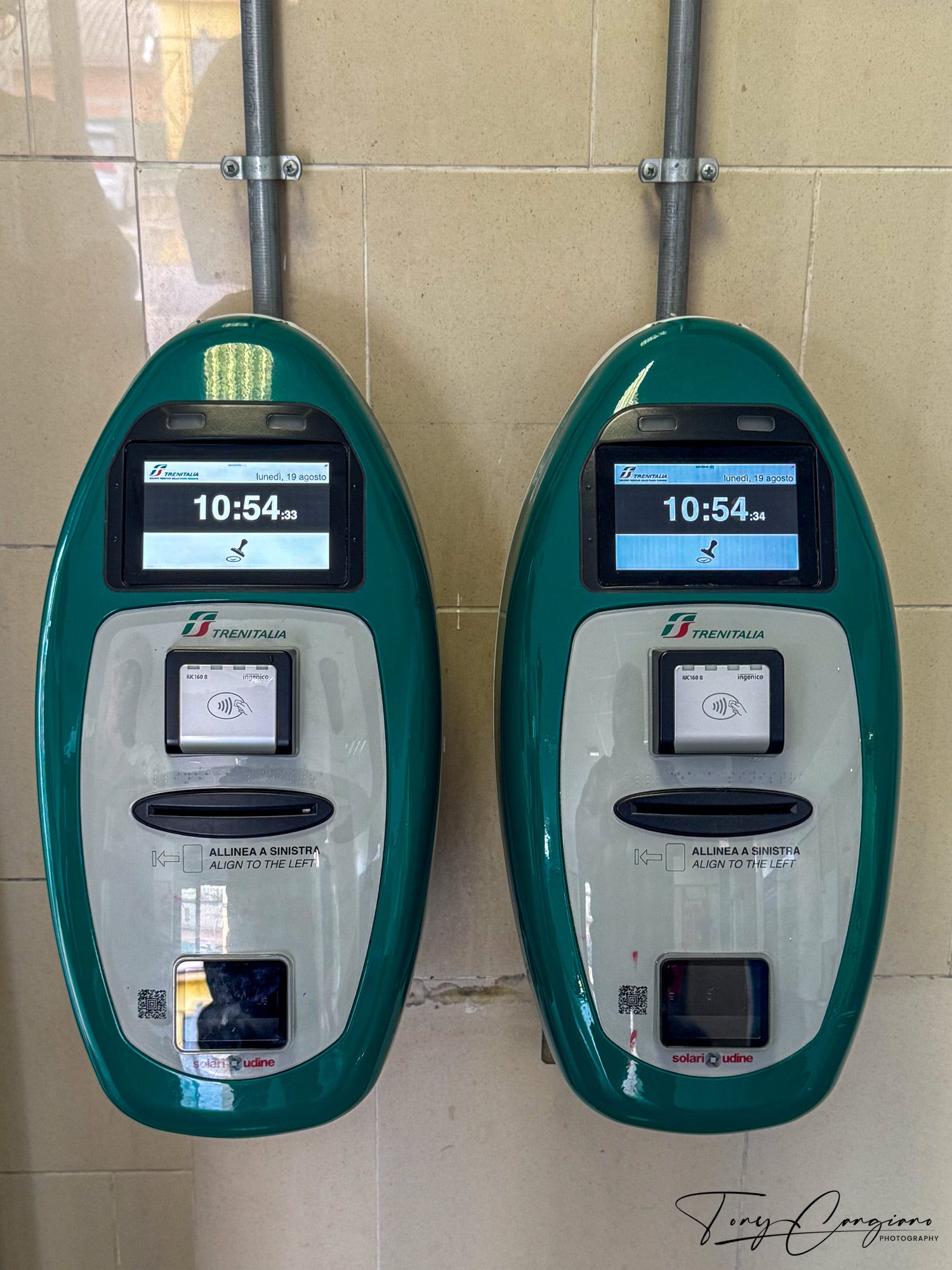
Validate your regional ticket before boarding. Find the small green or yellow box near the platform entrance, marked “Convalida il tuo biglietto”. Insert your paper ticket, wait for the stamp. Skip this step and a controllore will fine you €50 or more, and “I didn’t know” is not a defense.
Digital regional tickets bought on the Trenitalia app now check in automatically at departure time. You do not need to validate your digital regional train ticket at these machines. It is only valid for a specific date and time so there is no risk of you reusing it.
High-speed and Intercity tickets do NOT need validation either. They have a date and time printed on them. Show the QR code on your phone when asked.
Download your actual ticket. When you buy online Italo will send you the QR code in the confirmation attachment. Download the PDF on your phone for offline access and you’re good. Trenitalia will not. What they send you is a receipt not the actual ticket.
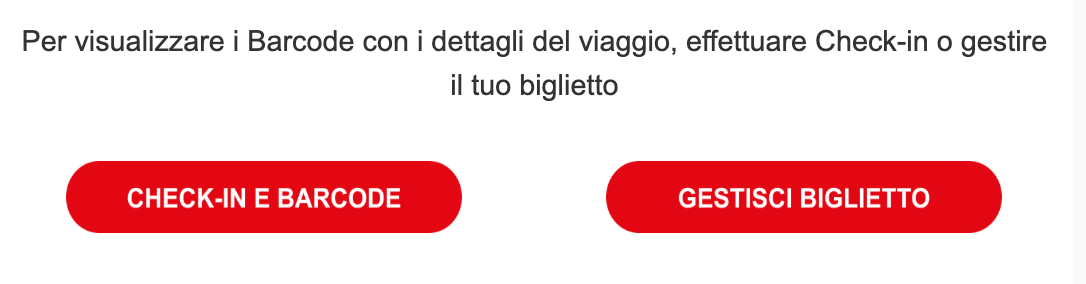
For the actual ticket click on the barcode button in the email and screenshot the screen including the QR code. That’s your actual ticket. No QR code, no valid ticket. Make sure you also have an ID on you. A controllore will require both.
You might also want to have a printed copy of your ticket, just in case your phone runs out of battery.
Watch your luggage. Italian Frecce and Italo trains have luggage racks at the carriage ends and overhead. The end racks are convenient and larger but they’re also typically out of sight from your seat. On a busy route, sit near them or use a small cable lock if you’re going to place them there. Theft is rare but not zero, especially at station stops where thieves will occasionally grab a bag and step off before the doors close.
Stations at night. Roma Termini, Napoli Centrale, and Milano Centrale are fine during the day but grim at night. Avoid lingering. The areas immediately surrounding Termini (e.g., Via Giolitti) and the streets behind Napoli Centrale aren’t dangerous in any serious sense, but they attract the kind of people you don’t want to face at 1 a.m. with a suitcase.
If you’re catching an early train, take a taxi from your hotel to the station rather than walking. For more on this, see my full guide on whether Italy is safe for travelers.
The “porter” scam. At Roma Termini, Napoli Centrale, and to a lesser extent Firenze SMN, you’ll be approached by men in vaguely official-looking jackets offering to help with your bags. They are not employed by the railway. The railway eliminated official porters at most stations years ago. They will help, then demand €5 or €10 per bag. Politely decline. “No grazie” works. Be firm. Walk on.
Don’t tip. No tipping at the biglietteria, no tipping the controllore (a crime, since it’d be a bribe), no tipping the food cart attendant. It’s not part of the culture, and it’s not done.
Pets travel free or cheap. Trenitalia allows small pets in a carrier (max 70x30x50 cm) for free, one per passenger. Larger dogs need a muzzle, a leash, and a ticket: €5 Sunday through Friday, €1 on Saturday. Italo allows small pets in carriers for free; for medium or large dogs, you add the “Dog” fare when booking, and the dog gets a mat in Smart or Prima class but must be leashed and muzzled. Some Executive cars do not allow pets on either operator.
Accessibility. Both Trenitalia and Italo offer free assistance for travelers with reduced mobility. Trenitalia coordinates through the Sala Blu service at major stations; Italo has a dedicated hotline (+39 06 07 08). Book at least 24 to 36 hours in advance through the website or by phone. Most Frecce and Italo trains have wheelchair-accessible carriages with bookable spaces.
Tight connections. Italian Frecce can be late by 5 to 15 minutes regularly enough that a 20-minute connection is a coin flip and a 10-minute connection is a bad idea. Build in 30 minutes if your itinerary depends on the second train. For the more paranoid among us, shoot for 60 minutes and enjoy a coffee break or quick meal at the station.
Snack bars. On that note, most stations have decent espresso and a passable cornetto. The bar at Bologna Centrale is genuinely good (try their piadina). The one inside the FrecciaClub at Roma Termini, if you have access, is excellent. The food cart on the Frecce is fine for emergencies, not for pleasure. The freebie they give you in business class is probably the worst snack you’ll have while visiting Italy. Edible but that’s it.
Reading the Boards and What to Do If You Board the Wrong Train
Every Italian station has two main boards: Partenze (departures, usually yellow) and Arrivi (arrivals, usually white). Find the yellow one. Look up your train number and destination.
The binario is shown on the right, often updated only 15 to 20 minutes before departure. If “binario” shows nothing, your platform hasn’t been assigned yet. Wait. Don’t ask the staff: they’re looking at the same board you are.
In some smaller stations you’ll still find paper timetables, the yellow Partenze and white Arrivi posters glued to a wall. The format is the same: train number, departure time, stops along the way, arrival time at major destinations.
If you board the wrong train, get off at the next stop. Don’t try to ride it back: that’s a different ticket and you risk a fine. Walk to the opposite platform, board the next regional going the right direction, and explain to the controllore.
If you bought a Frecciarossa and ended up on a regional going the same way, the controllore will sometimes let you stay with a small supplemento, sometimes not. I mean, technically you’re in the wrong and they could fine you. Honesty plus a slightly lost expression goes a long way. As always, knowing some Italian is super helpful.
If you’ve spent any time thinking about moving to Italy, the train system is one of the things that quietly makes daily life better than people assume. It’s a fantastic way to explore the country.
It’s one of the things I miss the most about Italy.
Frequently Asked Questions
How early should I book train tickets in Italy?
For Frecciarossa or Italo, book as soon as the schedule opens, which is roughly 90 to 120 days before departure. The cheapest fares sell out fast and prices climb steeply in the final weeks. Regional tickets have fixed prices, so booking those in advance has fewer benefits.
Is Trenitalia or Italo better?
Italo trains are newer and slightly more comfortable, with leather seats in every class and consistent service. Trenitalia covers far more of the country, including every regional route and most slower destinations. On routes where both compete (Naples-Rome-Milan-Turin-Venice), Italo usually wins on comfort and price, while Trenitalia often wins on schedule frequency. Compare prices and times for your specific route.
Can I use my Trenitalia ticket if I miss my train?
If you bought a Super Economy or Economy fare, no: missing the train means losing the ticket (unless you purchased the tiRimborso add-on at booking). Base fares can be changed for a fee. Regional tickets are valid for any regional train on the same route within four hours of validation, which gives you more flexibility than you’d expect.
Do I need to validate Frecciarossa or Italo tickets?
No. High-speed and Intercity tickets have a printed date, time, and seat assignment. Just show the QR code or printed ticket to the inspector. Only regional tickets without a fixed date and time need to be stamped in the obliteratrice before boarding.
What happens if there’s a train strike during my trip?
Strikes are announced days or weeks in advance. Check the MIT strike calendar before any long trip. Even during strikes, trains run during the fasce di garanzia (typically 6 to 9 a.m. and 6 to 9 p.m.) and Trenitalia and Italo publish lists of guaranteed trains the day before. If your train is cancelled, you’re entitled to a full refund.
Is it safe to travel by train in Italy at night?
The trains themselves are safe. The major stations (Roma Termini, Napoli Centrale, Milano Centrale) become less pleasant after midnight without becoming truly dangerous. Take a taxi from your hotel for early-morning departures rather than walking, watch your bag at all times, and decline help from men in vaguely official-looking jackets at the entrance.
Have you taken Italian trains? What surprised you, what tripped you up? Drop your story in the comments.
Italian rail travel is one of those rare things in life where the system is excellent and the rules are mostly fair, but only if you know what you’re doing.